


When Heat and Smog Team Up: India's Hidden Summer Air Crisis
Extreme heat and polluted air aren’t typically seen as related phenomena, even though they are. Rising temperatures and air pollution feed each other chemically and physically, creating greater risks together. Ground-level ozone is a clear example. Since this harmful pollutant forms faster in hot, sunny weather, a heat wave can push it to dangerous concentrations. A 2025 study from IIT Kharagpur found that ozone exposure during India's 2024 heat waves was linked to more than 26,500 deaths from heart and lung disease — roughly 900 more deaths than the same level of ozone would have caused without the heat. The heat itself was the difference.
How Heat Impacts Air Quality
Heat affects air quality in many ways. It can raise the layer of atmosphere from near the ground where pollutants mix and help disperse particulates, improving air quality. Heat also dries out soil, loosening dust, which is then lifted by the wind and traffic into the air as coarse particulate matter (PM10). This is particularly a challenge in Indian cities, which have frequent stretches of exposed and broken ground.
The biggest effect, though, is chemical. Heat drives the reactions that create secondary pollution — pollutants that form in the air rather than at the source — and this effect outweighs the benefit of pollutant dispersal. Ground-level ozone is one of the clearest examples of this phenomenon.
Ground-level Ozone as a Pollutant
Unlike the protective ozone layer in the stratosphere ("good ozone"), ground-level ozone is a harmful pollutant. Stratospheric ozone forms naturally when ultraviolet (UV) radiation splits oxygen molecules. Ground-level ozone, however, is not emitted directly by any source. Instead, it forms when nitrogen oxides (NOx) and volatile organic compounds (VOCs) — released by vehicles, industry and other everyday combustions — react in the presence of sunlight. Heat speeds up this reaction, and India's long, intense summer days give it more time for ozone formation.
The result is a pollutant that barely registered a generation ago, but now increasingly shapes summer air quality in Indian cities. There is also a compounding effect. Reaction rates that produce ozone rise exponentially with temperature, and heat simultaneously increases the raw materials feeding those reactions. Trees and vegetation emit natural VOCs and these emissions tend to increase as temperatures rise. In urban areas, these natural VOCs add up to the already present man-made VOCs, thereby increasing the dose of ozone precursors. Heat also evaporates more VOCs from fuel, solvents, and paints. Hotter days don't just speed up the chemistry; they add more fuel to the fire.
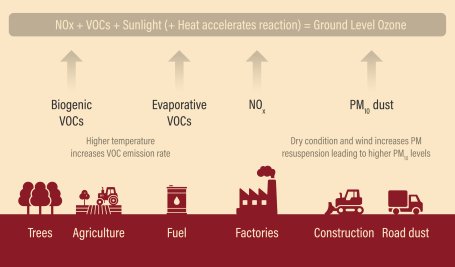
Moreover, heat doesn't produce the same sort of pollution everywhere; geography and existing emissions shape the outcome. Ground-level ozone illustrates this: its formation depends not only on temperature and sunlight but also on the local mix of pollutants that feed it.
Ozone chemistry depends on the local balance of its two ingredients, NOx and VOCs, and the relationship between these precursors and ozone production is non-linear. In traffic-dense city centers, there is usually plenty of NOx and comparatively little VOC, so cutting VOCs lowers ozone. Cutting NOx does little as it can lead to a temporal increase in ozone.
The Exponential Health Cost of Dual Exposure
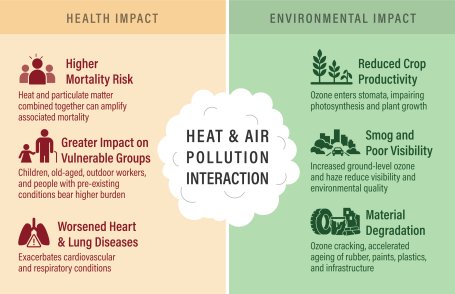
A California study found that the impact of extreme heat and elevated particulate matter (PM2.5) when combined, increased the risk of death by 21%. The dual exposure had greater effects beyond the sum of their individual effects. This evidence comes from temperate regions, but the researchers note that the real interaction effect in places like South Asia, where both heat and baseline pollution run higher, is likely worse.
Both heat and air pollution drive inflammation and oxidative stress in the human body. Heat also changes our physiology — hot conditions quicken our breath and blood flow, resulting in more polluted air moving through the lungs and bloodstream every hour. Children and older adults bear the brunt of this. The former, because their respiratory and temperature-regulation systems are still developing, and they spend more time playing outdoors. The latter, because they are more likely to have existing cardiovascular or respiratory conditions that are made worse by both heat and pollution. Outdoor workers face the harshest exposure of all, since they can't retreat indoors during a combined heat-pollution episode. Poor housing and limited access to cooling prolong their exposure to both, even after work hours.
The damage is not limited to people. Ground-level ozone also damages plants by disrupting photosynthesis and reducing crop yields, especially for ozone-sensitive crops like wheat.
What Can Be Done
The solutions must be rooted in an approach that treats heat and air pollution as a single problem. For instance, urban greening can help cool cities, while also filtering particulates and reducing the bare, dry ground that generates dust. Reflective and permeable pavements can cut both heat-island effects and dust. Transport measures such as better transit, electrification and less vehicle idling, can reduce vehicular NOx and VOC emissions, responsible for not just summer ozone, but year-round pollution.
An overdue fix is joint early-warning systems. India's Heat Action Plans, now covering over 250 cities and districts, have no air-quality trigger and air-quality plans have no heat trigger. Given how much warning infrastructure already exists on both sides, integrating them may be far cheaper than building something new.
Pollution control also needs to catch up on ozone. India's National Clean Air Programme (NCAP) targets a 40% cut in PM10 by 2026, but has no strategy for ground-level ozone, even as heat pushes it higher every summer. Controlling PM and ozone together means cutting NOx and VOCs. Cleaner vehicles under the latest Bharat Stage emission standards, fleet electrification and industrial controls cut NOx, which helps reduce both particulate matter and ozone pollutants. But VOCs from fuel evaporation, solvents, paints and petrochemicals are yet to be addressed under India's pollution strategy. Moreover, cutting NOx alone in a VOC-heavy urban core can push local ozone up, as seen in China where PM2.5 fell sharply through the 2010s even as ozone levels climbed. Research in India found that a 50% cut in NOx alone raised Delhi's ozone by 10–50%, while the same cut in VOCs lowered ozone by around 60%.
We cannot have a blanket approach for an entire city; interventions must be designed to target specific zones. Delhi's own data shows combined heat-pollution stress is concentrated in specific districts, particularly central, eastern and northwestern zones. Citywide averages can hide the hotspots where action is most necessary (see Figure 3).
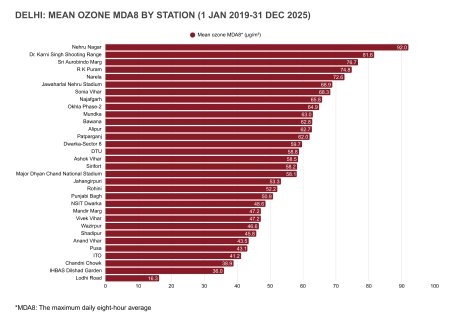
Source: Seven years of data from Continuous Ambient Air Quality Monitoring Stations (CAAQMS) operating across Delhi
As temperatures rise, heat and pollution won't just coexist; heat will continue manufacturing new pollution, shifting where and when it peaks, and amplifying its cost to human health well. Treating them as interconnected challenges is the most efficient way to direct policy attention and limited resources to where they can have the greatest impact and offer better health outcomes for all.
Additional contributions and editorial inputs by Nitisha Singh.