


Powering Possibilities for Rural Enterprises in Jharkhand
Imagine travelling 10 kilometres to access refrigeration, tailoring, milling, photocopying and digital services. For a village of nearly 5,000 people in Jharkhand, this was life not too long ago. In Palamu district’s Burhibir village, the absence of reliable electricity diminished opportunities and agricultural returns, pushing young people toward cities.
Even today, while households in Burhibir have electricity connections, local enterprises still struggle due to frequent supply disruptions. The lack of reliable electricity limits people’s access to enterprise and essential services, but decentralised renewable energy (DRE) interventions could change that.
Building Local Enterprises Through Decentralised Renewable Energy
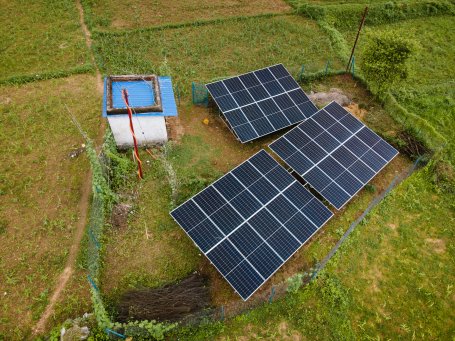
To address this gap, Transform Rural India (TRI), in partnership with WRI India, installed a 17 kilowatt-peak (kWp) solar-powered mini grid in the village. The mini grid supports four enterprises — a flour mill, a tailoring unit, a paper plate and bowl manufacturing unit, and a common service centre — along with the Panchayat Bhavan.
These enterprises were selected through an assessment of entrepreneur interest, local service gaps and community demand, conducted with the help of TRI, the block office and the Gram Sabha.
Institutional Setup
The intervention emphasises community ownership to inspire trust and encourage participation. The mini grid is managed by a village energy committee (VEC), comprising four entrepreneurs, the village head and two ward members. The committee oversees the operations and maintenance, tariff settings, tariff revisions and decisions regarding the inclusion of future entrepreneurs. The VEC ensures that the services remain relevant and accessible to all.
The mini grid is situated centrally with the enterprises in a two-kilometre radius. Entrepreneurs own and manage the machinery, having contributed 30% of the capital cost of their enterprise, while TRI supported with the rest along with technical and handholding support.
Strengthening Local Services
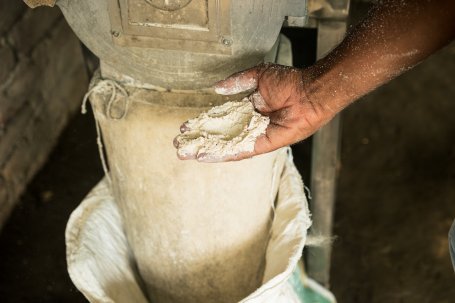
The intervention has created livelihood opportunities that address critical service gaps. The flour mill has become particularly valuable to the community, as villagers can get grain, spice and corn processed at a flat fee of ₹3 per kg. This has reduced travel time and household expenses, while reducing dependence on electric mills elsewhere.
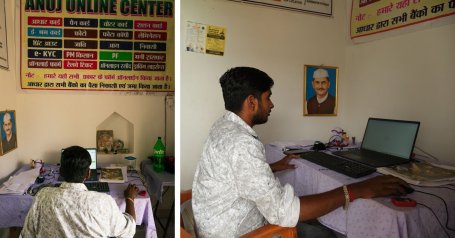
The Common Service Centre (CSC) serves as a one-stop shop for digital and financial services, helping people access government schemes, photocopying and lamination. Anuj Yadav, a local entrepreneur, also provides door-to-door support to the people in the village with a laptop, extending the centre’s reach.
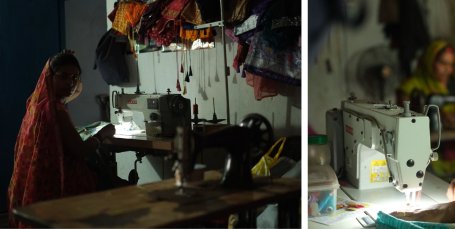
“Earlier we used to have to pay ₹5 for one photocopy outside the village, now we just pay ₹2,” says Anuj pointing out the benefits of having an accessible and affordable common service centre in the village. The tailoring unit, run by Nagwanti Devi, has mostly transitioned to solar-powered operations, reducing manual effort. It now offers improved speed, stitching consistency and advanced stitching functions.
Together, these enterprises have begun to shift the community’s economic imagination. Burhibir’s youth are beginning to see village-based entrepreneurship as a viable livelihood pathway. By offering alternate livelihoods, DRE interventions could gradually reduce seasonal and distress migration among young people.
Learning Through Trial and Error
Like with many rural livelihood interventions, the entrepreneurs encountered challenges in Burhibir. While the mini grid originally planned to support five enterprises, not all of them progressed as planned. The paper plate unit faced intermittent demand and marketing challenges. The challenge of procuring low-cost, quality raw materials also raised operational burdens for the entrepreneur. A planned pulse-processing unit also failed to sustain operations. Since the multi-step nature of the process demanded significant time and effort, the entrepreneur lost interest in using the machinery.
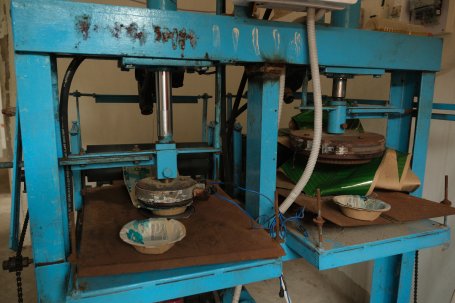
Maintenance also emerged as a persistent challenge. The unavailability of spare parts and servicing support in local and adjacent markets meant that even minor machine-related issues required external intervention, with long waiting periods that disrupted operations.
These experiences underscore an important lesson: energy infrastructure alone is insufficient. For DRE interventions to succeed in rural areas, access to local service ecosystems, supply chains for raw materials (such as lamination sheets or diverse fabrics), market for products, and skilled local persons are just as important as the electricity itself.
Rather than viewing these setbacks as failures, TRI and the community treated them as a learning opportunity. Continuous engagement with entrepreneurs, the VEC and local institutions can improve utilisation and governance, thereby sustaining the intervention in the long run.
Beyond Burhibir
The Burhibir experience demonstrates that decentralised renewable energy systems can play a larger role that goes beyond providing clean energy. The solar mini-grid became a platform for local entrepreneurship, improved services, new livelihoods and off-farm economic opportunities. The latter is particularly important since Burhibir largely relies on rain-fed agriculture that does not provide year-round income security.
At the same time, it shows that reliable electricity and technology alone cannot sustain rural enterprises. Long-term viability of such models depends on community ownership, organisational support, entrepreneurial capacity, pragmatic business plans and market linkages. The paper plate enterprise demonstrates that rural businesses must navigate operational and market-related challenges alongside energy access.
The ripple effects are visible. People from neighbouring villages have visited Burhibir to understand how the solar-powered mini grid supports local enterprises, highlighting a growing interest in DRE-enabled livelihoods as a pathway to stronger rural economies and local economic resilience.
Photographs by Akshay Ingle and Parag Sarwade for WRI India.