


Beyond Credits: The Potential of Impact Labels
Global climate finance has more than doubled since 2018, but it must grow at least fourfold by 2030 to limit the rise in global temperature to 1.5°C. India has committed to sourcing 60% of its installed electric power capacity from non-fossil fuel sources by 2035 and achieving net-zero emissions by 2070. As private entities and countries work towards their climate commitments and sustainability targets, climate finance mechanisms, like carbon markets and renewable energy certificates (RECs), can help them measure and offset their emissions while directing funds toward sustainability initiatives.
The voluntary climate finance market enables companies to purchase climate instruments to support their sustainability goals, meet net-zero commitments and offset their emissions. These instruments include carbon credits, each representing one tonne of CO₂ equivalent reduced or avoided and RECs denoting one MWh of renewable energy generation. For example, a company in Germany can buy RECs generated from a solar farm in India to offset its Scope 2 emissions, which are emissions from purchased electricity. In turn, the revenue from the sale of RECs can help finance the solar farm’s ongoing operations.
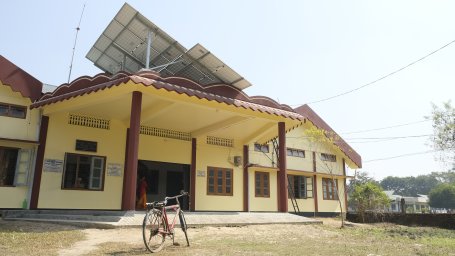
However, this market has not been equally accessible to the relatively smaller, kilowatt-scale clean energy projects like decentralised renewable energy (DRE) systems. DRE systems provide communities with reliable access to clean energy in energy-constrained areas. Beyond households, they also power healthcare facilities, schools, and other productive uses of renewable energy, such as cold storage, agro-processing and irrigation pumps. Despite their potential, DRE systems have primarily relied on grants and government subsidies to offset their high, upfront capital costs and operation and maintenance (O&M) expenses.
What are Impact Labels?
Impact labels are an emerging instrument that go beyond measuring how much renewable energy is produced to capture the social and developmental outcomes of the project. DRE-powered projects sit at the intersection of environmental and socio-economic impact and can access the voluntary climate finance market through impact labels to generate additional revenue.
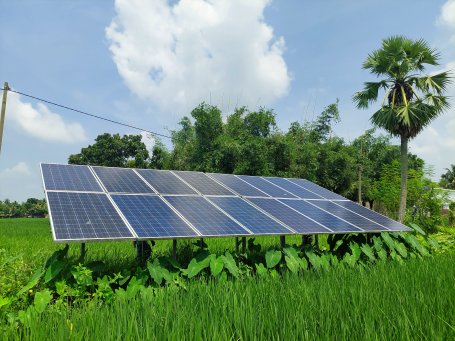
Existing instruments such as carbon credits and RECs are primarily designed for utility-scale projects. For small-scale systems like DRE, the costs involved in transaction, monitoring, verification and certification end up being disproportionately high, particularly in the absence of mechanisms to aggregate distributed energy assets. Impact labels such as decentralised renewable energy certificates (D-RECs) and peace renewable energy credits (P-RECs) can allow small-scale clean energy projects to access the larger voluntary climate finance market.
Impact labels are certification tags that highlight social or environmental impact. They enable DRE projects (as small as one kWp) to link corporate demand to community impact. Since they certify DRE projects in energy-constrained regions that deliver tangible social benefits to communities, they are referred to as “high-impact” labels. For instance, the streaming platform Netflix purchased D-RECs generated by a solar-powered eye hospital in Uttar Pradesh. Netflix (buyer) was able to claim scope 2 reductions and social impact, while the hospital received access to a reliable source of electricity and additional revenue to sustain the system.
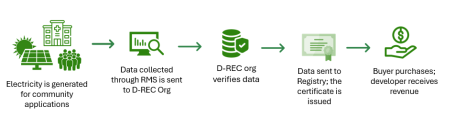
In our recent working paper, we analysed D-RECs — an impact label active in India — by the D-REC Organization. The certification process is straightforward; electricity generated by a DRE system is monitored remotely, verified by the D-REC Organisation and sent to a global digital registry that issues the certificates. Buyers can buy these certificates, and revenue from the sale is shared with the DRE developer. Compared to some other RECs and carbon credits, D-RECs are sold at a premium price due to their additional social impact value. The price ranges from 20 to 30 US$/MWh for a certificate.
The key stakeholders in the process are DRE developers, corporate buyers, the registry, the D-REC organisation that verifies the generation data, and the intermediaries, who facilitate the transaction between buyers and developers.
Understanding Opportunities and Challenges
The primary motivation behind creating D-RECs was to remove the initial barriers to DRE projects entering the climate finance market. Long-term agreements between developers and buyers provide predictable revenue that can help create additional emission reductions, which would not have happened without additional finance. Buyers have the flexibility in choosing projects across geographies and impact areas (healthcare, education, livelihoods, etc.) and aligning their investments to their corporate vision. Developers find the instrument useful for accessing the larger climate finance market. The sale of certificates represents only a fraction of their project revenue (3-15%), which can support O&M costs and help them pursue new DRE projects.
As the mechanism evolves, it must address several challenges. Currently, the definition of a high-impact project remains open to interpretation, and there is limited transparency in pricing mechanisms and revenue utilisation. The communities that underpin these projects are also not informed about the sale of certificates.
The ongoing revision of the GHG Protocol, the accounting framework underpinning these instruments, introduces further uncertainty. Proposed changes, such as stricter deliverability requirements and hourly tracking of electricity generation, could limit the eligibility of off-grid DRE projects.
Way Forward
To build an efficient ecosystem, it is important to ensure that there is a reliable demand for and supply of these certificates. Therefore, building awareness about the mechanism amongst developers and buyers, while navigating the uncertainties related to GHG Protocol revisions, is crucial. Despite existing challenges, this mechanism offers an innovative approach to advancing an inclusive energy transition and scaling reliable energy access in remote and rural areas.