


Why Ecological Restoration is Vital Infrastructure for the Climate Transition
For many years, I viewed ecological restoration as a distant cousin of sustainable agriculture. Agriculture always seemed more demanding: farmers navigate ecological uncertainty, climate variability, markets, labour constraints and livelihoods, making trade-offs between productivity and resilience every season.
Restoration, by comparison, appeared deceptively straightforward: plant enough trees, fence off degraded land and wait patiently. The assumption was that nature would remember what it used to be. But through my work on Soils at the World Economic Forum and on Restoration for a Harit Bharat at WRI India, I have come to realise how incomplete that understanding was.
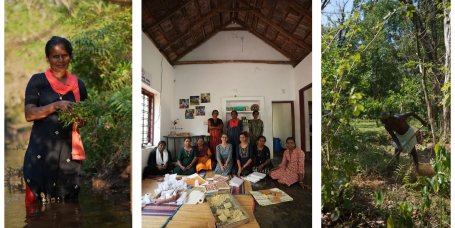
What has changed most for me is not the importance of restoration, but how I understand what it is trying to do. More trees do not necessarily produce healthier ecosystems. A forest is not simply a collection of trunks and canopy; it is a web of relationships — fungal networks exchanging nutrients underground, pollinators moving across habitats, predators shaping prey behaviour and rivers flooding at natural intervals. Healthier ecosystems are not just created by more trees; they demand a revival of ecological processes. This is becoming clear in the global debate on rangelands.
From Planting Trees to Restoring Ecosystems
Rangelands are open areas of land, often dominated by native grasses. They cover 54% of the Earth's land surface, support around two billion people and are stewarded by some 500 million pastoralists. Comprising natural grasslands and other dryland ecosystems, they do not necessarily benefit from being converted to tree plantations, as they often serve grazing communities and ecosystems unique to them.
At the 17th session of the Conference of the Parties (COP17) to the United Nations Convention to Combat Desertification (UNCCD) in Mongolia, the discussion around rangeland restoration highlighted both the economic value of these landscapes and the risks of applying the incorrect restoration model. Rangelands exemplify how the best intervention for some landscapes is to restore ecological processes, grazing systems and community institutions that allow them to function. Restoration, in other words, must begin with understanding how a landscape works, rather than deciding in advance what we want it to look like.
Restoring Processes, Not Just Landscapes
For decades, restoration's success was measured in hectares replanted or saplings distributed. Governments, businesses and NGOs counted trees by the million. Yet recent evidence suggests that monoculture plantations offer surface-level greenery rather than supporting functioning ecosystems.
A recent article in Nature Reviews Biodiversity argues that biodiversity should be a key outcome of restoration, rather than an afterthought to planting trees. That changes the questions we ask. Have pollinators returned? Have soil microbial networks recovered? Have food webs reconnected? Has the ecosystem regained its ability to function? These questions point to a simple principle: diversity and ecological function matter more than density alone.
Studies also show that sometimes the most effective intervention is not doing more but knowing when to do less. Recent global syntheses have found that natural regeneration — the recovery of vegetation and ecosystem functions through naturally occurring processes such as seed dispersal, sprouting, ecological succession along with passive restoration — can support substantial recovery, particularly where ecological processes remain intact.
What is Passive Restoration?
Passive restoration helps landscapes recover by removing or reducing pressures such as grazing, fire or fragmentation.
Restoration as Investment: The Climate Finance Barrier
Climate resilience depends on the health of ecological systems that serve as natural infrastructure. Yet global climate finance still struggles to value these services in ways that shape investment decisions.
United Nations Environment Programme’s State of Finance for Nature 2026 report finds that investment in nature-based solutions must increase 2.5 times — to US$571 billion annually by 2030 — to meet global biodiversity, climate and land restoration goals. But the issue is not simply about mobilising more climate finance. It is also about how development finance defines value.
As governments and multilateral development banks broaden their focus from narrowly defined climate finance targets to wider development outcomes, an opportunity is emerging. But ecological systems that underpin resilience risk being overlooked in investment decisions precisely because they are harder to measure.
Financial systems are ill-equipped to adequately reward positive restoration outcomes. Energy investments, by contrast, generate returns — megawatts installed, emissions reduced and revenues forecast — with relative precision. Restoration works differently. Healthy ecosystems regulate rainfall, recharge groundwater, support pollination, reduce disaster risk and strengthen long-term resilience. Their value is systemic — and often recognised only after it has been lost.
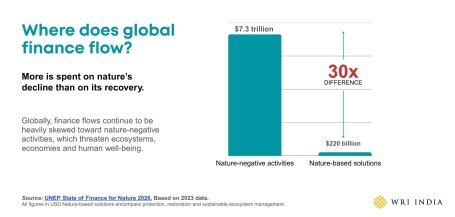
The irony is hard to ignore: we are investing trillions to reduce carbon emissions and shift economies towards renewable energy, while underinvesting in the living systems that make those economies resilient.
What are nature-negative activities?
Activities that directly harm nature, such as clearing native forests for agriculture.
Decarbonisation without ecological resilience risks creating a low-carbon future built on degraded watersheds, declining soil fertility, collapsing biodiversity and unstable climate impacts. Restoration is therefore not a niche environmental investment competing with the energy transition — it is part of the infrastructure that makes the transition durable.
Restoring for the Future, Not the Past
Climate change is also transforming how restoration defines success. Historically, ecologists focused on what ecosystems existed before a disturbance. The more useful question now is what ecosystem can survive the future. Scientists now work with the idea of “novel ecosystems” — ecosystems that may never resemble the past but can still function, adapt and sustain biodiversity under future climatic conditions. Increasingly, restoration is about understanding what can endure a changing climate.
Restoration planning now draws on climate-resilient genotypes, future rainfall projections, heat tolerance and computational modelling. At WRI India, we have begun exploring what becomes possible when agricultural datasets interact with restoration potential, energy systems, biodiversity mapping and water-stress projections, simultaneously.
Better information, however, does not simplify decision-making. Every landscape decision must navigate competing pressures from livelihoods, energy demand, conservation, food systems and climate resilience. Modern capital markets are extraordinarily effective at recognising the monetary value of extraction, production and short-term outputs, but far less capable of valuing resilience, interdependence and ecological stability.
The longer financial systems fail to recognise that ecosystems are not externalities but foundational infrastructure, the greater the risk that restoration becomes a defining blind spot in the climate transition.
Three shifts would change the trajectory. First, tie restoration finance to outcomes such as groundwater recharge, soil carbon and species return. Second, classify ecological restoration as infrastructure in public capital budgets and development bank taxonomies to unlock long-term capital. Third, redirect nature-negative subsidies towards practices that restore ecosystems.
Restoration has always asked us to understand how living systems change and adapt, and to work with the relationships that sustain them. This may be the deeper lesson on resilience for development finance too: restoration is not something we install once. It requires ongoing support for the living systems we are trying to restore. I used to think of restoration as the simpler cousin of sustainable agriculture: plant, protect and wait. I now see it very differently.