


Building India’s New Restoration Economy
We are living in a time when planetary degradation and rising inequality are locking people out of economic prosperity. Nature is being pushed past its limits; the climate is destabilising and the world has crossed the 1.5°C threshold of global warming. To achieve India’s ambitious vision of Viksit Bharat@2047 and its Net Zero 2070 commitment, India needs to recognise that nature offers a pathway.
As climate risks grow and rural economic distress deepens, restoring nature needs to become central to India’s growth story. India’s degraded forests, grasslands, commons and agricultural lands are economic engines that sustain over 700 million people, especially small and marginal farmers and forest-dependent communities.
India’s Restoration Opportunity
India has a significant opportunity for forest protection and landscape restoration across nearly 100 million hectares. Realising this potential could sequester 3-4.3 billion additional tons of carbon by 2040 and mitigate climate impacts. Restoration, however, is far more than planting trees. In Sidhi district of Madhya Pradesh, for instance, unlocking this potential through 3,000 restoration microenterprises around species like bamboo, jackfruit and moringa could generate 30,000 new jobs.
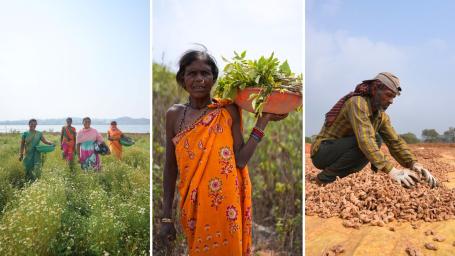
Effective ecological restoration strategies are hyperlocal and tailored to prioritise ‘right place, right use, right species,’ taking into consideration landscape principles and people’s priorities. Examples of restoration interventions include agroforestry, commons and grassland restoration and supporting natural regeneration.
India’s challenge and opportunity lie in building a “New Restoration Economy,” a model where ecology and livelihoods grow together. This requires governments, businesses and communities to invest in restoring nature in a way that creates jobs, enables sustainable food production and protects natural systems that support clean water, healthy soils and biodiversity. Restoration offers a high-return, community-centred development pathway at a time when climate impacts are deepening, and rural economies are under stress. The returns are compelling: Every US$1 invested in restoration can yield up to US$30 in economic benefits.
Encouragingly, the signals from the Government of India are already pointing in this direction. There is a growing focus on promoting green growth and a green economy, reversing land degradation, and enhancing the rural economy through circular production principles and climate-resilient practices. This is complemented by a range of monetary and non-monetary incentives for restoration, such as scaling trees outside forests through interventions like agroforestry.
India’s start-up ecosystem, the third largest globally after the United States and China, is another pillar supporting this transition. Young innovators are driving advances in financial technology (fintech), agriculture technology (agritech) and the services sector. India can build on this momentum and cultivate a thriving restoration value chain ecosystem. Restoration value chains are enterprises that develop innovative business models (e.g., around mahua, bamboo) that create economic value while restoring and nurturing nature. Supported by accelerators like the Land Accelerator South Asia, such startups and farmer-producer companies demonstrate what the new restoration economy can achieve – creating jobs, restoring millions of hectares, engaging millions of farmers and building value chains for sustainably sourced restoration products.

The Missing Piece
Finance, however, remains a hurdle. Globally, restoration faces a major finance gap of nearly US$215 billion annually. At present, most of the global funding for restoration is public funding (US$47 billion), while private funding (US$17 billion) remains comparatively limited. India has emerged as a frontrunner in public investment for restoration, with about US$13 billion invested in protecting and improving tree cover between 2011 to 2016. However, more is needed to scale these efforts.
Governments, businesses and financial institutions must work together to create an enabling environment for innovation and infrastructure. This will bridge capacity gaps and signal to the market that public policies that protect and restore nature have long-term economic value. Like any other industry, India’s restoration economy needs to evolve through three stages: fragmented innovation, marketplace building and mainstream maturity. India is already witnessing the first stage, as scattered innovation and promising models emerge.
The government, civil society and private sector should work together to build a thriving restoration marketplace. This will include building enabling infrastructure, improving access to finance (innovative blended finance structures) and strengthening the absorptive capacity of restoration businesses through concessional loans and de-risking innovations through first loss coverage. Once the marketplace strengthens, restoration can mature into a mainstream, high-impact economic sector enabling jobs, resilience and sustainable growth – all integral to India’s vision of a Viksit Bharat@2047.