


Observations from the Wild: Sharing Space with Tigers
The first time we took our daughter to a wildlife reserve was a decade ago; she was just two years old at the time. Thus began the annual family ritual of visiting Maharashtra’s Tadoba Andhari Tiger Reserve (TATR). Over the years, we have watched the demand for jungle getaways grow. On our recent trip, despite planning three months ahead, there were no safaris available for us in the core area. Instead, we had to settle for one of the 20 buffer zones that surround it.
In 2025, over one lakh tourists visited the reserve. Located less than two hours from Nagpur airport, TATR has a clear advantage. One can take a morning flight from Mumbai, Delhi or Bengaluru and be on a safari by afternoon. Wildlife reserves are making their way into holiday itineraries with greater fervour as wildlife videos and tiger sightings take over social media feeds.
While this growing interest is exciting, it surfaces an essential question: What happens when more people, more tigers and more villages begin sharing the same space?
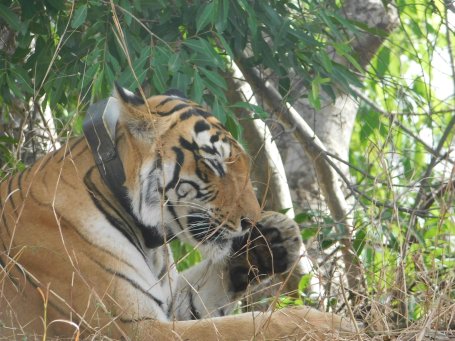
Tigress T-7 And Her Cubs
Tigress T-7 was one of the first two tigers collared in the reserve. She claimed the Jamni meadow area in the core as her territory. In March 2016, we saw her with two sub-adult tigers. One of those cubs grew up to become the famous T-126, who went on to establish his territory in the Ramdegi and Navegaon buffer areas.
The other cub did not survive. As is common with sub-adult males, he left the park in search of territory and a mate. He was found dead — electrocuted by an illegal fence set up by a farmer several hundred kilometres away. Sub-adult tigers have been recorded to travel more than 300-400 kms in search of territory, but only 40% manage to establish it and reproduce.
In April 2023, we saw T-7 again. She was walking around the park and was clearly in distress. She would stop by the side of the road, making crying and wailing sounds. The naturalists and guides told us she was looking for her few-months-old cub who had gone missing. A tiger mother will search for a lost cub for at least two weeks. More often than not, cubs are killed by other male tigers competing for territory and mating privileges.
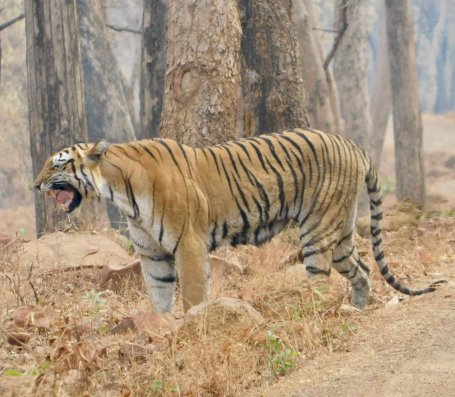
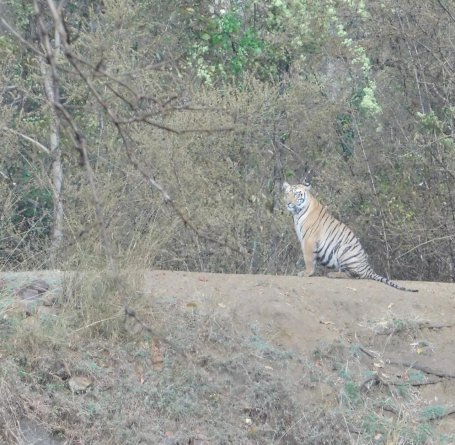
Fortunately, this cub survived. When we visited again in April 2024, we saw him — now a strapping, one-and-a-half-year-old sub-adult tiger — hanging out with his “nephew.” He had been accepted into the litter of T-7’s daughter — a rare occurrence in tiger behaviour. All the guides referred to them as mama-bhanja (uncle and nephew).
He was resting on a bund while his young uncle was stalking a one-eyed bison a little further. Soon after, we saw a sloth bear in the distance heading towards the bund, oblivious of the tiger’s existence. We were close enough to witness a growling match between the two animals, with the sloth bear literally standing up to the tiger. As I witnessed one of my most memorable jungle experiences, a thunderstorm broke out, and lightning struck not very far from where we were. All of us, drenched to the bone, watched this exciting duel when suddenly a nest of weaver ants landed in our jeep. Our driver quickly threw a wet handkerchief on it and tossed it out of the car expertly.
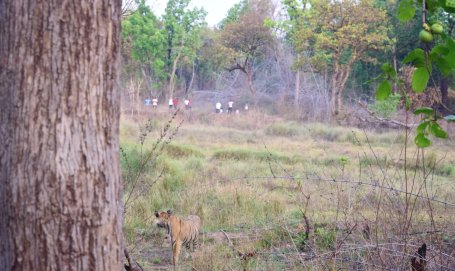
When we returned in April 2026, the same cub, now three and a half years old, had established territory in one of the buffer areas. One morning, we saw him feeding on a cattle carcass in a field right next to a village. Armed villagers gathered in a large group and chased him away, while a forest officer at the scene did his best to manage the situation. The farmers dispersed once they were assured that they would be compensated for their lost cattle.
When Success Becomes Complicated
These experiences are a small window into TATR’s growing tiger population. As they have grown from 15 tigers in 2010 to around 115 today, the prey population needed to support them has not been able to keep pace. With local food sources stretched, tigers begin to move into nearby villages and prey on cattle. There is always the worry of villagers poisoning carcasses when tigers venture too close. And then there is the increase in direct human-tiger conflict. The forest department has reported around 184 human deaths from tiger attacks in Chandrapur district between 2021 and 2025.
Despite this, TATR offers important lessons on coexistence and cohabitation. Local communities have been drawn into the conservation story through multiple interventions. Building on what already works, real and lasting success will depend on several things coming together.
A collaborative network of government bodies, local authorities, and non-profit partners have undertaken several ongoing grassland and ecosystem restoration efforts along with practical, on-the-ground support for the people living beside this recovering wilderness. Livestock veterinary services, fencing of waterbodies, and better health services for local communities all reduce the everyday friction points where tigers and people compete for the same resources, leading to potential loss of life.
If loss of cattle or life does occur, the forest department has introduced mechanisms to ensure quick compensation. They have also employed the Payment for Ecosystem Services (PES) approach so that people who live with the costs of conservation also share in its benefits. Tourism-based revenue is channelled back into the community, giving people a reason not just to live next to tigers but to recover some of the cost of sharing space with their feline neighbours. Training for locals to become guides and naturalists combines their instinctive knowledge of the land with courses in wildlife management, English language, hospitality and related skills. This ensures that they are not merely living on the periphery of a growing industry but are part of the conservation conversation.
The habitat itself needs attention too. As tigers expand their territory into buffer zones, there are growing efforts from the forest department, civil society organisations, and CSR funders to support forest protection, rewild degraded lands, protect and restore grasslands, improve water availability and strengthen habitats. If these efforts help the prey population grow, tigers may be less likely to venture into farms and fields.
Efforts are also being made to help local communities improve their livelihoods through non-timber forest produce (NTFP). Earnings from mahua, honey and other NTFPs incentivise the protection of these sensitive zones. TATR’s Weed to Wealth initiative is another interesting project where women from buffer villages are trained to identify and remove invasive weeds to restore the health of the land.
Sal Leaf Livelihoods in Bastar's Forests
Read how value-addition to raw materials and NTFPs like pressed Sal leaf plates is helping local SHGs.
I am not a conservation expert, but as someone who works on issues of environment, sustainability and climate change, I know none of this happened overnight. Change requires consistent, systematic effort over many years. TATR's growing tiger population is a result of the changes that began when Tadoba and Andhari were brought together in the 1990s. The next phase of change is now underway, and it will be interesting to see how it unfolds.
Above all, real long-term success depends on deepening our understanding of coexistence and our awareness of our interdependence with all life. Our tendency to anthropomorphise tigers like T-126, and turning individual animals into celebrities, can narrow how we think of conservation and who it must include. It risks turning these lands into protected fortresses or museums to be visited by the elite few, while pushing the people, who live with the everyday costs of conservation, to the margins. There is a need to deepen our understanding of conservation-through-coexistence with a much wider community of people. And for these efforts to endure, coexistence needs to be treated seriously, with local communities not just representing, but also steering the story.
All photographs by Madhav Pai/WRI India.