


Decarbonising Aviation: Exploring the Potential of E-Kerosene
This is the first blog in a two-part series on the challenges and the key drivers of e-kerosene. It introduces the basics of e-kerosene and outlines the challenges to its commercialisation.
Aviation knits the world together, and as demand for air travel rises, that role comes with climate implications. India’s fleet is projected to expand from around 400 aircraft in 2014 to approximately 2,359 by 2040. For a country with a growing population and a vast geography, aviation is essential infrastructure. However, aviation also accounts for around 2–3% of global carbon dioxide (CO₂) emissions. Since aircrafts need energy-dense liquid fuel, aviation is one of the hardest sectors to decarbonise.
A Drop-In Decarbonisation Solution
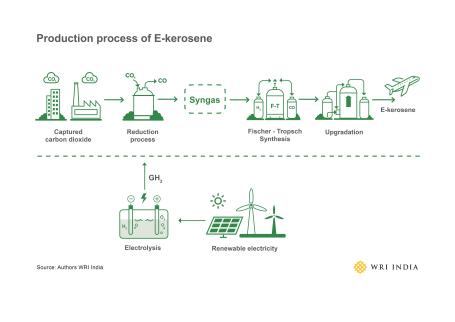
E-kerosene offers an alternative to conventional jet fuel and can deliver significant lifecycle greenhouse gas reductions. It is a synthetic jet fuel made from renewable electricity, water and CO₂ captured from the atmosphere or industrial sources (Figure 1). Since it works in existing aircraft and fuelling infrastructure without any modification, it does not need new engines or new airport infrastructure.
Nearly every clean energy technology — solar, wind, batteries — has followed the same arc: costs fall faster than experts expect, owing to policy, investment and accumulated experience. E-kerosene is in the early stages of that curve, but it's moving. To examine E-kerosene’s progress, we must first identify the barriers it faces.
How is e-Kerosene Made?
E-kerosene production has three stages:
Green Hydrogen production: Water is split into hydrogen and oxygen through renewable-powered electrolysis.
CO2 conversion: Captured CO2 is combined with hydrogen to form carbon monoxide. Together with unreacted hydrogen, this forms syngas — a key intermediate in fuel production — through the reverse water-gas shift (RWGS) reaction or co-electrolysis using solid oxide electrolysis cells.
Fuel synthesis: Syngas is converted into liquid hydrocarbons via Fischer–Tropsch synthesis, then refined into aviation-grade e-kerosene — chemically identical to conventional Jet-A1 fuel. The key difference is that instead of adding new fossil carbon, CO₂ is captured from the air or industrial sources and converted into fuel.
The Road to Scale
E-Kerosene features in net-zero aviation pathways and emerging European mandates, yet commercial scale remains out of reach. The production pathway is well-understood; what stands in the way is a mix of technical, economic and system-level challenges that must be examined.
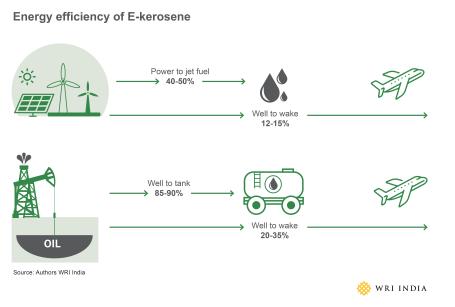
Every conversion step loses energy, and since e-kerosene involves more conversion steps than conventional fuel, those losses compound. The overall efficiency of converting renewable electricity into usable jet fuel, which is known as power-to-jet fuel efficiency, sits at 40–50%, compared to 85-90% for conventional jet fuel.
Aircraft engines then convert about 20–40% of the fuel’s energy into useful propulsion — this is similar for both fuels. As a result, the overall efficiency from energy input to propulsion is around 12–15% for e-kerosene, versus 20-35% for conventional jet fuel (Figure 2). This efficiency gap is one of the central technical challenges e-kerosene must overcome to reach commercial scale.
Source: Aviation and the Global Atmosphere.
Securing the Supply of Carbon Dioxide
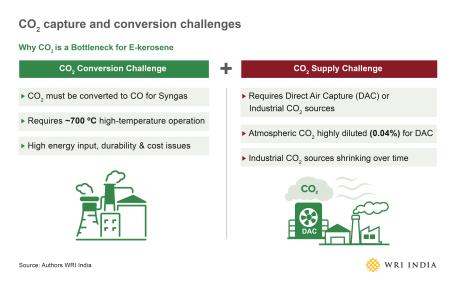
E-kerosene needs a reliable, sustainable CO2 source and finding one at scale is harder than it sounds. Direct air capture (DAC) is the ideal long-term option, pulling CO2 directly from the atmosphere. But atmospheric CO₂ is highly diluted (~0.04% by volume), making capture energy-intensive and costly. Around 19 DAC facilities operate globally today, capturing just over 9,000 tonnes of CO₂ annually — a fraction of commercial requirements.
CO₂ can currently be sourced from industries such as cement and steel, but these cannot be relied on in the long term as their emissions will decline with decarbonisation. Meanwhile, converting CO₂ to carbon monoxide for syngas production requires temperatures of around 700°C, adding efficiency losses and capital costs (Figure 3).
Bridging the gap between today's limited CO₂ capture capacity and the volumes that commercial e-kerosene production would require is a challenge that the industry is still working through.
The Cost Challenge
Techno-economic analyses estimate that e-kerosene is currently 5–6 times more expensive than conventional jet fuel. The full cost per kilogram accounting for capital, operating and financing expenses over the plant's lifetime is around €5–6 per kilogram (approximately ₹540 - 650/kg), against below €1 per kilogram (₹107 – 108 / kg) for fossil jet fuel. Renewable Electricity and plant capital expenditure (CAPEX) are the main drivers of cost at 44.1% and 33.5%, respectively. Electrolysers are the single largest component of plant CAPEX, and their costs fall as manufacturing scales. India's National Green Hydrogen Mission — targeting 5 million metric tonnes of green hydrogen by 2030 with an investment of ₹19,744 crore — is one such example, scaling domestic electrolyser manufacturing and potentially positioning India as a future e-kerosene producer.
These cost pressures have a direct consequence for passengers. Ticket price impact analysis shows that even a modest 5% e-kerosene blend in conventional jet fuel increases average ticket prices by around 6-7%. Understanding what drives these costs is key to understanding how they can be brought down.
Beyond the Barriers
The barriers explain why commercial deployment will take time, but they do not tell the whole story. Renewable electricity, water and atmospheric CO₂ — e-kerosene's core inputs — are theoretically abundant. The barriers to scaling e-kerosene are actively being researched and addressed globally. Electrolyser costs have been falling steadily for years, direct air capture capacity is growing and pilot projects around the globe are already producing synthetic aviation fuel, generating the experience that larger deployments will build on.
E-kerosene offers a promising alternative that could transform aviation. The question is whether the right conditions — technical, economic, and political — can be created fast enough to meet India's decarbonisation targets.
The next part of this series will explore the key enablers and interventions needed to address these challenges and support the commercialisation of e-kerosene.