


Can Behavioural Science Improve Urban Mobility?
Since its emergence as a global tech hub in the 1990s, Bengaluru draws thousands of jobseekers each year. Its infrastructure has struggled to keep pace, and the most visible result has been traffic congestion.
Today, Bengaluru is the second most congested city in the world. An average commuter in Bengaluru loses roughly seven days a year to peak-hour delays. The city’s transport agencies have responded by investing heavily in bus and metro systems. With 6,952 buses, Bengaluru has one of the biggest fleets of public buses in India. The city is also home to India’s third-longest metro network spanning 96 kilometres. Yet congestion persists, pushing policymakers to find new ways to reduce reliance on personal vehicles.
The Station Access and Mobility Program (STAMP) tackles this problem through behavioural science. Launched in 2016 by WRI India with support from the Toyota Mobility Foundation, STAMP’s first edition set out to improve last-mile connectivity to metro networks across seven Indian cities. It focused on the supply side of urban transport: offering commuters more last-mile options to reach the metro.
However, a working paper based on this edition revealed a second opportunity. Research showed that commuters earning over ₹60,000 a month rarely use the metro. This constituted a demand-side challenge: there aren’t enough incentives for this demographic to choose public transport.
Addressing Demand Gap Using Behavioural Science
Habits can often play a greater role in travel choices than service availability. Studies have found that personal vehicle users rarely switch modes even when public transport improves.
Behavioural science uses insights from psychology, sociology and economics to understand why people behave the way they do. Applications of behavioural science involves identifying and addressing barriers to specific behaviours – How can more people be encouraged to donate blood? How can people be encouraged to file taxes? – and designing interventions to address these barriers. In our case, we asked: How can more people be encouraged to take public transport in Bengaluru?
We found that people often respond to surprisingly simple cues, such as knowing that their colleagues take the metro, earning points for leaving the car at home, or receiving a small reward for choosing a more sustainable commute. These everyday triggers, drawn from behavioural research, have been used around the world to shift commuter habits. They are cost-effective, easy-to-implement strategies that can complement infrastructure. Most importantly, as the examples below show, they work.
Behavioural Strategies: Success Stories
1. Kenya: The Zusha! Road Safety Campaign
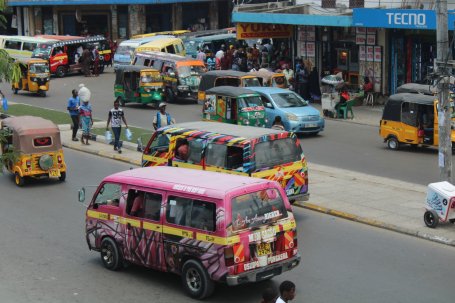

Zusha! (Swahili for ‘protest!’ or ‘speak up’) was a cost-effective behavioural road safety campaign in Kenya designed to encourage a safer driving culture. In sub-Saharan Africa, road crashes are among the leading causes of death for people between 5 and 29 years of age. Many of these deaths occur in minibuses, locally known as matatus, the primary mode of transportation in the region. Matatu crashes are often attributed to reckless driving, overspeeding and illegal overtaking.
The Zusha! campaign placed highly visible stickers inside matatus encouraging passengers to speak out against bad driving. Randomised controlled trials conducted by Georgetown University and J-PAL showed that vehicles with these stickers registered 25-50% fewer insurance accident claims, translating to 140 avoided accidents and 55 lives saved annually.
The Zusha! programme demonstrated that cost-effective behaviourally informed approaches can successfully improve road safety and can meaningfully complement infrastructural interventions.
2. Singapore: INSINC – A Platform to Manage Public Transport Demand
In 2012, Singapore’s Land Transport Authority (LTA) sought to ease overcrowding on its metro during rush hour. Launched as a Stanford/National University of Singapore trial in January 2012, Incentives for Singapore Commuters (INSINC) was an initiative that managed peak-hour travel demand by encouraging commuters to travel during off-peak hours.
INSINC was a web-based, frequent-commuter program, similar to an airline miles program, run through a personal INSINC homepage. Participants could invite friends via Facebook, Gmail, and Yahoo! mail connections. Friends were displayed on INSINC’s page in a ranked list, with off-peak commuting friends shown at the top. Players earned credits (1 credit per km on weekday trips, 3 credits per km for trips in the off-peak hours). Credits could be redeemed either at a fixed exchange rate of 1,000 credits = S$1, or for prizes ranging from S$1 to S$100 through a raffle. About 87.6% of participants preferred the raffle option over the fixed cash-out, consistent with people's general preference for a raffle over a small certain payment.
In a six-month pilot, the scheme successfully shifted 7.49% of peak-hour demand, meaningfully managing demand through incentives and behavioural nudges.
3. India: Infosys-Stanford Traffic Project (INSTANT)
Infosys’ Electronic City campus had a morning gridlock problem. Thousands of employees arrived at the same time in company-chartered buses, creating massive congestion. To address this, Infosys partnered with Stanford University and deployed the INSTANT project — a behavioural approach that rewarded employees who arrived before the peak rush.
Each participating employee earned 1.5 credits for swiping in at work before 8 AM (early off-peak hour) or 1 credit between 8 and 8:30 AM (off-peak hour). There was no reward for swiping in after 8.30 AM, the peak window itself. At the end of each week, participants who had accumulated at least 3 credits were entered into a draw for cash prizes. The mechanism was designed so that more credits translated into a higher probability of winning. Employees who arrived early frequently accumulated more entries for the raffle. Reward amounts paid out through this raffle mechanism ranged from about Rs. 500 to Rs. 12,000 per week.
By the end of the six-month experiment, the number of commuters arriving before 8:30 a.m. doubled, and the average morning bus commute time fell from 71 to 54 minutes.
The examples above show the potential of behavioural strategies — gamification, peer recognition and monetary incentives — to encourage positive behaviour. Behavioural approaches in India, where despite a big urban mobility challenge not enough people use public transport, can offer huge dividends. While programmes like INSTANT are encouraging, such approaches have rarely been applied on a large scale systematically, to encourage public transport use.
WRI India’s STAMP: Nudging Commuter Behaviour program uses behavioural science to shift commuters towards public transport, with a focus on high-income, corporate employees. By combining behavioural nudges with financial incentives, STAMP is targeting choice users and incentivising them to take public transport where services already exist.
Bengaluru, as the epicentre of Global Capability Centres (GCCs), offered a large pool of corporate employees who could participate in STAMP. The launch of a new metro line connecting Electronics City presented an opportunity to pilot the program in partnership with corporates. The pilot used a mix of interventions, including social norms, financial incentives and gamification, to encourage employees to shift towards public transport. Based on learnings from Bengaluru STAMP: Nudging Commuter Behaviour can be scaled up to other cities.
The second blog in this series will explore the strategies deployed by corporate leaders in Electronic City, Bengaluru, to shift employees from personal vehicles to public transport.