


RESTORE 2026 brings Stakeholders Together to Explore how India can Build Resilient Landscapes and Livelihoods
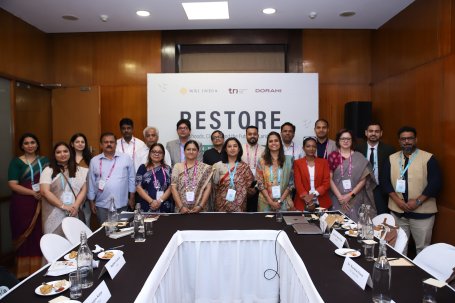
New Delhi, October 15, 2026: Strengthening collaborative action towards ‘Restoration for a Harit Bharat’, WRI India, Transform Rural India (TRI) and Dorahi co-organised ‘RESTORE 2026: Livelihoods, Climate and the Future of Landscapes’ in New Delhi on October 14–15 2026.
Building on the inaugural edition in 2025, the event explored how landscapes can be restored to withstand climate change, sustain livelihoods and meet growing demands on land and water. The two-day national dialogue brought together 400 participants including government, philanthropy, finance, business, technology, civil society, researchers, practitioners, entrepreneurs and community leaders.
Explaining the vision behind RESTORE, Dr. Ruchika Singh, Executive Program Director, Food, Land and Water, WRI India said “Restoration must be about people, their livelihoods and the natural systems they depend on. As climate change alters how our landscapes function, we need to rethink how we plan, restore and manage them. RESTORE brings people working across these areas into the same conversation, which is essential to finding solutions that can be scaled.”
The event also saw the launch of two research reports: From Pilot To Scale: Lessons in Community-Led Landscape Restoration in Sidhi, Madhya Pradesh by WRI India and Reading the Landscape: Communities’ Assessment of their Landscape by TRI. Neeraja Kudrimoti, Practice Director (Climate Action), TRI, shared that “Effective climate action must begin with an understanding of how the interconnections of landscapes and people are changing at the hyperlocal level. Our latest report shows how community knowledge can strengthen planning, investment and action for resilient rural futures.” Shloka Nath, CEO and Founder, Dorahi, added that “India has the pledge and the people to restore its present into a Harit tomorrow. What’s missing is money built around trees that survive, native species and the communities that look after them. Our work is to back that recovery and lay the groundwork for stronger public and private capital to follow.”
The event featured “India’s Landscape Stories,” an exhibition showcasing place-based restoration experiences, livelihood and value-chain innovations, community stewardship, restoration enterprises and digital tools implemented by ‘Restoration Champions’ across India. It presented champions including Jarsang EcoVision, Van Gujjar Tribal Yuva Sanghatan, GREEN Foundation, The Rewilders, Ashoka Trust for Research in Ecology and the Environment, Centre for Advanced Research & Development, WWF-India Sundarbans Delta Programme, Gramya Ventures, Nature Connect India, ArkaShine Innovations Pvt. Ltd. and KriSHE Carbon.
Together, these stories highlighted the diverse ways restoration is taking shape across India and the people driving it. Across the two days, participants explored a range of issues shaping the future of India’s landscapes, including measuring restoration beyond tree plantation, restoring landscapes in a hotter India, food systems that work with nature, commons and indigenous stewardship, rivers and aquatic systems, landscape corridors, and new ways of financing restoration. “In a hotter India, healthy landscapes are critical to water security, food production and rural livelihoods. We can count the hectares, but it’s the people doing the work who can tell us what’s coming back and what it takes to sustain that recovery. That’s why it’s a privilege to host RESTORE with Transform Rural India and Dorahi and bring Restoration Champions to the stage. What excites me is the momentum we can now carry back into the landscapes where this work happens,” said Jaskiran Warrik, Head of Restoration, WRI India.
The discussions underscored a common need: rather than remain a collection of disparate projects, restoration must become integral to how India plans and manages its landscapes. Achieving this will require stronger participation from communities, more institutions to work together, and sustained public and private finance to support restoration over the long term.