


Rising Heat’s Invisible Burden on Delivery Workers
In Delhi’s scorching summer afternoons, delivery riders can often be seen waiting outside restaurants, huddled under flyovers or parked beside charging stations with wet towels draped around their necks. For the city’s rapidly expanding fleet of gig and delivery workers – from food and grocery delivery to courier and logistics workers – extreme heat is becoming an occupational hazard, creating unforeseen risks for their livelihoods.
Quick Deliveries, Slow Recovery
Rakesh Kumar* works as a delivery rider in Faridabad (on the border of Southeast Delhi) for a prominent food delivery platform. He begins his shift before noon and often continues until late evening, spending almost the entire day outdoors. This year’s heatwave has been unlike anything he has experienced. “By 2 or 3 PM, it feels like the road itself is burning,” he says. “Sometimes I stop under a flyover for ten minutes because I feel dizzy. But if you stop too long, you lose orders.”
For workers like Rakesh, income depends on completing a high volume of deliveries during ‘peak hours,’ many of which coincide with the hottest parts of the day. Missing these windows means losing out on incentives that make up a substantial portion of daily earnings.
Conversations with gig and delivery workers across Delhi revealed recurring complaints of fatigue, dizziness, headaches and dehydration. Many riders said they are increasingly forced to stop intermittently in shaded areas, near metro stations, or outside air-conditioned shops simply to recover before continuing work. Similar stories of increasing occupational heat stress are emerging from workers in India’s small industrial units and shopfloors.
Unlike workers in the formal sector, informal workers often lack regulated rest periods, access to cooling spaces, or employer-provided health protection. This matters, particularly for gig workers, because the structure of platform work incentivises continuous movement. Slowing down is a trade-off between physical well-being and financial survival.
Overheating Smartphones and Income Losses
Riders also describe how extreme heat increasingly disrupts the technological systems they rely on to complete orders. Smartphones — effectively the workplace infrastructure of gig and delivery workers — frequently overheat during prolonged outdoor use. Workers report that phones often shut down automatically and data-intensive delivery apps freeze while navigating routes in direct sunlight. Rakesh describes how his smartphone, mounted on his bike throughout the day, often becomes unusable during the afternoon. “The app hangs or the phone switches off automatically,” he explains. “Then orders get cancelled and sometimes we are blamed for delays.”
Since workers cannot accept or complete orders while disconnected from the platform, temporary shutdowns mean lost income. More concerningly, several workers reported being penalised for delayed or missed deliveries despite these disruptions being heat related. Unlike traditional employers who may compensate workers for equipment breakdowns, platform companies often classify such interruptions as the individual worker’s responsibility.
Interrupted Charging for Electric Vehicles
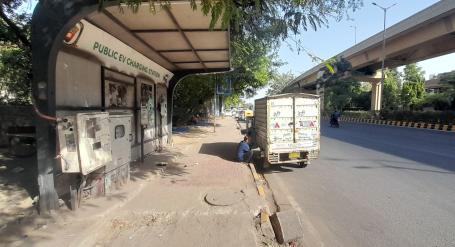
A few kilometres away in South Delhi, Imran Sheikh*, a delivery worker with a popular logistics platform, waits beside an electric vehicle charging station. He shifted to an electric three-wheeler last year, hoping to reduce fuel expenses, but says the ongoing heatwave has created new challenges.
“When the battery gets too hot, charging slows down or stops in between,” he says. “I have to wait up to an hour longer than normal in summer to get enough charge to continue working.”
Several workers using electric two- or three-wheelers describe similar experiences. Fast-charging systems often interrupt charging cycles when batteries overheat, leading to longer waiting periods for charging and reduced productivity. For workers dependent on maximising the number of daily deliveries, these delays can substantially reduce earnings. While electric mobility is rightly promoted as part of India’s low-carbon urban transition, these accounts suggest more needs to be done to ensure electric delivery fleets are climate resilient.
Fuel Anxiety Amid Geopolitical Disruptions
The recent oil-supply disruptions due to the ongoing conflict in West Asia have added another layer of challenges. Workers using petrol or diesel vehicles describe longer queues at fuel stations and growing anxiety around fuel price volatility. Since fuel costs are borne by workers themselves, even a modest price increase can significantly erode their already-thin margins.
“Some of my friends using petrol bikes have recently spent hours in queues at fuel stations and complain about the economic hardship caused by the recent increase in petrol prices,” Imran says. “But whether it’s electricity or petrol, the pressure is on us workers only.”
Compounding Risks of Climate Change
What emerges is a picture of cumulative stress. A worker navigating 45oC temperatures may simultaneously experience physical exhaustion, phone malfunction and charging delays or rising fuel expenses. Climate risk, technological risk and energy market volatility are effectively outsourced onto individual workers.
The experiences of delivery workers demonstrate the importance of recognising differential vulnerability in climate resilience planning, since exposure to heat risks is shaped not only by geography, but also by occupation, income security and access to infrastructure.
Possible Solutions
Some states have begun experimenting with measures for labour protection during extreme heat. Maharashtra, for example, recently introduced Standard Operating Procedures (SOPs) for outdoor informal workers that mandate staggered work hours, compulsory rest breaks during peak afternoon heat, shaded rest areas, hydration support and emergency medical preparedness during severe heat alerts.
Moving beyond emergency response measures, some states are adopting longer-term heat-resilience strategies. Tamil Nadu’s recent Heat Mitigation Strategy emphasises the importance of identifying vulnerable livelihoods and communities, integrating heat resilience into urban planning, and developing targeted interventions for groups disproportionately exposed to heat stress.
Building on such efforts, urban local bodies could develop heat-action protocols specifically tailored to gig and delivery workers, including provisions like compensation protection during heat-related technological failures, platform-supported access to hydration and cooling facilities in high-demand delivery zones, and delivery fee adjustments during periods of fuel price volatility.
At a broader level, the experiences of workers like Rakesh and Imran reveal how app-based urban convenience depends heavily on workers absorbing environmental and economic shocks in real time. For many workers, the crisis is not simply about heat, fuel or technology alone. It is about what happens when all of them converge at once in lives already defined by insecurity.
*Names have been changed to protect the identities of workers.