


Peeling the Layers of Maharashtra’s Onion Supply Chain
Rabi onions are special. Unlike Kharif onions, farmers often store them for months after harvest. Since they are sown during the early winter months (October-November) and harvested in the drier months (April-May), they develop a stronger outer skin and lower moisture content, making them suitable for long-term storage.
India is the world’s largest onion producer, accounting for 27% of global production. Yet about 7.26% is lost post-harvest annually in India.
Maharashtra is the biggest onion producer in India. The farmers here have been growing onions for decades. What began as a crop for household consumption, gradually expanded with the growing population and demand, and is now a major source of income for farmers.
In this blog we follow a farmer’s journey in Nashik district of Maharashtra, through the rabi cycle — from harvest to market — looking closely at the different stages of the onion supply chain to reveal barriers, risks and opportunities.
Growing Onions
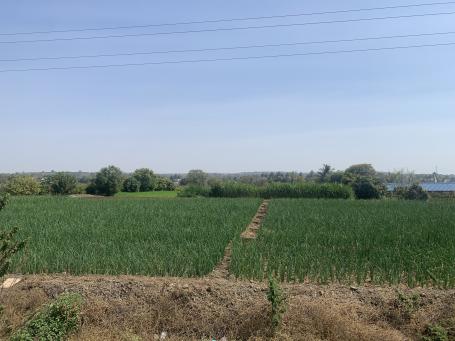
A 42-year-old farmer* from Golegaon village owns 4 acres (1.62 hectare) of land and supports a family of seven. He and his wife grow soybean and maize in the kharif season, and onion and wheat in rabi. Although land allocation for crops depends on current prices, previous season’s profits, trade barriers and risk-taking ability, he has consistently cultivated onions on 2 acres for the past five years.
Ready to Harvest
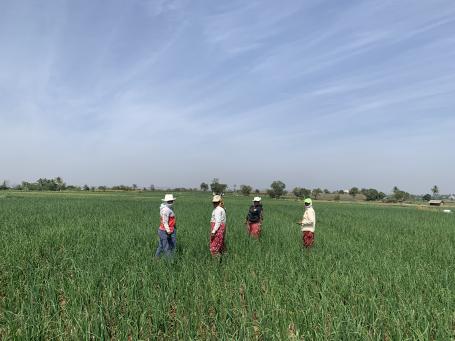
The onion cycle takes about 120-130 days. The farmer knows it is ready for harvest when the leaves begin to topple, and the bulbs reach the desired size, though the timing may be adjusted if rain is expected.
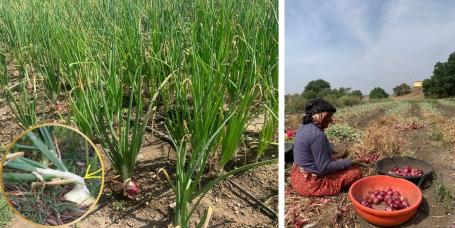
Harvesting is done manually — onions are uprooted by hand, sometimes with the help of a small sickle to loosen hardened soil. He works alongside hired labourers to finish harvesting on time, while his family sometimes helps from sunrise to sunset.
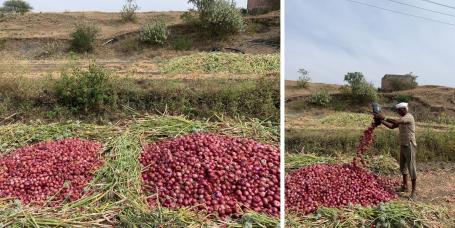
After harvesting, the stems are trimmed, leaving about a finger’s width near the bulb, a practice passed down through generations. This helps the neck seal naturally, reducing risk of infection and improving storability, since the neck is a common entry point for rot-causing pathogens. The bulbs are then collected in plastic tubs, buckets, or jute sacks (Photo 3). Smaller or slightly deformed bulbs are sorted out and sold quickly in local markets, as they lose moisture faster and fetch lower prices. Early sorting also helps prevent storage losses, since a single rotting bulb can spread infection in dense piles, especially in warm and humid conditions.
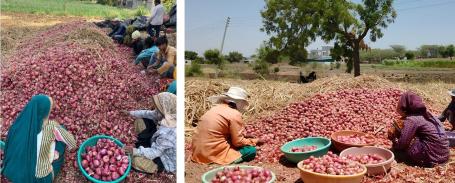
Small batches are gathered at a collection point on the farm, covered with leftover leaves, and sun-dried for about 10–15 days. This process, known as curing, removes excess moisture, improves appearance and reduces the risk of diseases during storage. Unexpected rainfall is a concern at this stage, as even one unseasonal shower can undo curing progress and increase spoilage risk.
Ready to Store
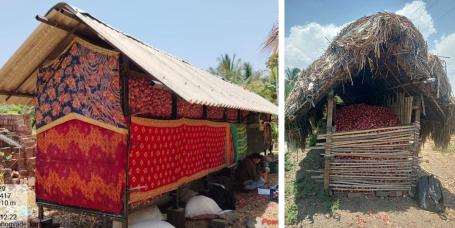
After curing, the farmer must decide how much onion to store and for how long. They are then stacked 5-6 ft high in a storage structure near the farm, sometimes covered with a cloth or plastic sheet to protect them from severe heat and rain.
The farmer’s family regularly monitors the stored onions for early signs of rot or infestation, including pungent smells and changes in stack height. Spoiled bulbs are discarded and often dumped near the farm.
Most storage losses occur due to weight loss from moisture, high temperature, humidity, ventilation and poor quality at the onset. The farmer does not maintain a written record of the quantity discarded or costs incurred beyond input purchase receipts. To assess the best time to sell, he tracks market prices and bases his decision on his financial needs, weather conditions and information from other farmers or family members.
Time to Sell
The farmer takes his produce to the nearby Lasalgaon mandi — Asia’s largest wholesale onion market — where onions are sold loose in tractor trolleys. He usually sells in batches and sometimes grades the bulbs to get better prices.
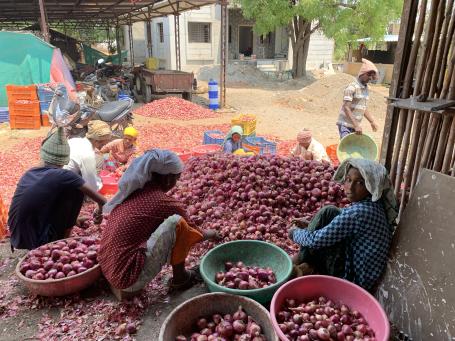
Since onions cannot be stored indefinitely, he weighs the chance of better prices against the risk of quality loss. In 2025, he waited until early October but had to sell it eventually despite unfavorable prices. Price volatility, influenced by trade barriers and weather changes, adds uncertainty. In extreme cases, farmers even discard produce — often near the farm — if transport and labor costs exceed expected returns.
Need for Action
India has largely achieved self-sufficiency in terms of meeting domestic onion demand. But expanding its global presence requires improving year-round affordability, efficiency and competitiveness to meet quality requirements.
The future of onion cultivation in Maharashtra depends on addressing multiple challenges through improved storage solutions and post-harvest management practices, greater value addition, robust weather advisory systems, and more stable export policies. The state government's initiatives for scientific storage infrastructure and value addition signal progress that can be scaled across the onion belt in the state.
Producing onions offers both opportunity and risk. We need simple, cost-effective solutions in the short term, alongside strategic investments over the long term. While onions remain a lucrative crop with both domestic and global demand, the journey from farm to market requires collaborative efforts of diverse stakeholders.
A combination of policy interventions, technological upgrades and market diversification can ensure sustainable livelihoods for smallholders and improved affordability for consumers.
*Name withheld on request.