

Fi-ZET: Powering India’s Transition to Electric Freight
Every morning before sunrise, Raghav, a truck driver from Bhiwandi in Maharashtra, begins his day by loading his vehicle for yet another inter-city trip. Week after week, he moves the goods that keep shops stocked, factories running and markets alive. Millions like Raghav contribute to the quiet machinery that keeps India running.
Trucks form just 3% of all vehicles on Indian roads, yet they carry over 70% of the country’s freight by volume. However, road freight generates 53% of the country’s particulate matter (PM) emissions and accounts for more than 25% of India’s annual oil import expenditure.
Decarbonizing road freight can help safeguard these critical economic networks and the people at the helm of it. Drivers like Raghav spend long hours on highways and loading bays where diesel exhaust is especially pervasive, making them particularly vulnerable to the adverse health impacts of a high-emissions freight system.
Electric trucks offer a promising alternative with the potential to cut freight emissions by almost 46% annually by 2050. However, zero-emission trucks are projected to account for only ~0.09% of India’s total medium-and heavy-duty vehicles in 2025.
What Is Holding Back Electric Trucks?
Electric trucks can cost two to three times more than diesel models, but the purchase price is only one part of the challenge. Operators face a combination of equally critical barriers — limited access to affordable financing, higher interest rates, steeper insurance premiums, and uncertainty around long-term cash flows, all of which hinder large‑scale adoption.
When operators say “Do e-trucks actually make sense for our business,” they are navigating uncertainties around financial constraints and operational realities with limited information. What has been missing is a way to check the commercial viability under real operating conditions.
Recognizing this gap, WRI India developed the Fi-ZET (Financial Impact Assessment for Zero-Emission Trucks) tool that allows users to adjust key operational inputs and simulate multiple use cases based on the distinct operating realities of their routes and business models, in a simple and intuitive way.
Fi-ZET: A Tool Built for the Realities of India’s Freight Sector
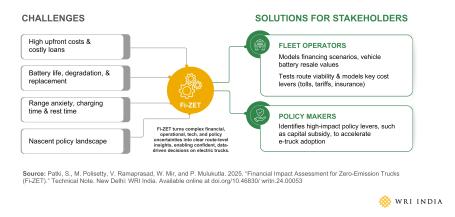
Designed specifically for the freight sector, Fi-ZET’s value lies in how it clarifies the full economics of running an e-truck. It compares diesel and electric trucks at the route level, capturing how each vehicle performs in practice.It estimates how quickly the truck can recover its upfront cost (payback), how much it can earn over its lifetime (earnings), what it truly costs to own and operate (total cost of ownership), and how cash flows evolve over time. It can also generate a full financial statement based on real operational inputs such as the distance a truck runs while earning revenue (revenue distance), how fully it is loaded on trips (payload utilization), and the time spent charging.
Together, these inputs provide a clearer picture of financial performance under real-world conditions. Users can adjust financing terms, electricity tariffs, assess the impact of policies, and account for operational hiccups to instantly see how results shift.
This is crucial because adoption is not determined by “Total Cost of Ownership (TCO) parity” alone, but by commercial viability, reflected in cash flows and profit. Fi-ZET breaks these questions down and shows what it would take for an electric truck to operate reliably and profitably.
Using the Fi-ZET Tool to Model a Real-World Operation
To understand what Fi-ZET reveals in practice, consider one of Raghav’s regular freight assignments: moving steel coils from Pune to Asal in Maharashtra, a predictable 220-kilometre round-trip operation. On most days, trucks run fully loaded and about 70% of return trips also carry goods. A regular operation like this can make fleet owners wonder: could an electric truck perform this job as reliably as a diesel truck?
To explore this, WRI India used Fi-ZET to model an operational comparison between a 55-tonne diesel truck and an electric alternative. The diesel truck, with a 40-tonne load carrying capacity, costs about ₹45 lakh, while the electric truck, with a 38-tonne capacity is priced at around ₹1 crore. Note: Actual prices may vary depending on the original equipment manufacturer (OEM) and contract terms.
While the upfront cost of the electric truck is higher, Fi-ZET reveals what truly matters to operators — when the investment breaks even, how cash flows evolve over time, how incentives alter the economics of operations, and how operating margins compare across the two options.
Using FiZET, both trucks were evaluated over an eight-year, first-ownership period with a five-year loan tenure. Furthermore, it was assumed that both trucks are purchased on loan at a 9.5% interest rate.
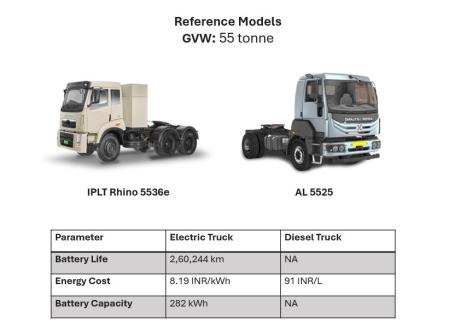
Explore the interactive graphs below to uncover payback and watch the brief video covering cost-of-ownership insights across the baseline and multiple other policy scenarios.
How Policy Incentives Shift the Viability of e-Trucks
As illustrated in the infographics, the tool enables users to establish a clear baseline without policy support and adjust various policy and financing levers to observe how outcomes shift.
More importantly, the tool captures how these parameters interact with one another to shape overall viability. Instead of offering a simple yes-or-no answer, Fi-ZET enables users to see how payback period, total cost of ownership (TCO), cash flows and net earnings respond dynamically to specific inputs. This capability helps users move beyond static comparisons and understand the financial mechanics driving investment decisions.
For operators, this clarity helps them determine when an electric truck becomes feasible for specific routes. For policymakers and financiers, it shows where targeted interventions can unlock faster and cost-effective adoption.
Charting India’s Transition to Electric Trucking
The example above reflects the real choices fleet operators navigate every day — which routes are viable, how costs and cash flows shift across trips, and whether an e-truck can deliver dependable earnings in a highly competitive market. Fi-ZET cuts through this uncertainty by translating complex financial and policy variables into clear, route-level insights that operators can trust, while also helping policymakers identify which interventions genuinely improve on-ground viability.
India’s freight sector stands at a pivotal moment — decisions around ZETs will shape not only balance sheets and emissions trajectories, but the daily realities of the people who keep goods moving. Smarter tools can enable smarter investments, cleaner operations and healthier working environments for drivers like Raghav, whose early mornings and long hauls quietly support the economy.
We invite you to explore Fi-ZET in your work.
If you have questions or would like a walkthrough or workshop, we’re happy to support you.
