
Powering Healthcare
Delivering integrated clean energy solutions to improve service delivery and reduce emissions in India.
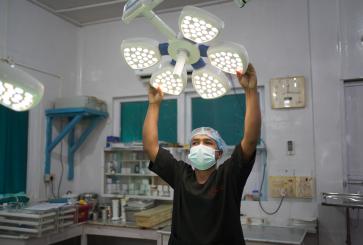
Electricity is essential for most healthcare services – from diagnostics to conducting surgical procedures. Without electricity, a health facility cannot ensure a sterilized environment for patients, or store life-saving medications and vaccines. Even for basic requirements such as lighting, heating, cooling, pumping water, record keeping of patients, and training – electricity is a necessity. In a post-COVID-19 world, the roll out of new technologies such as telemedicine services in remote areas requires a reliable source of electricity.
Despite significant efforts by the government, several thousand health sub-centres and Public Health Centres (PHCs), which are often the first point of contact for communities seeking basic healthcare, do not have reliable electricity services. Many facilities with an electricity connection suffer from poor quality of power with frequent outages lasting several days and weeks, especially during extreme climate events such as storms and floods.
The lack of reliable electricity causes an interruption in service delivery, preventing health facilities from investing in life-saving equipment. To overcome this, some may rely on expensive diesel generator sets causing local air pollution and other negative externalities. Cumulatively, the lack of reliable and clean power supply can affect rural and remote communities that need healthcare services and the environment, causing local pollution and adding to India’s overall carbon emissions.
Given the gaps in electricity infrastructure in the health sector, WRI India works with partners to implement customized renewable energy (RE) solutions suited to the needs of healthcare facilities. So far, the team has worked with the Catholic Health Association of India, Basic Healthcare Services, and Emmanuel Hospital Association to deliver clean energy solutions to facilities across the states of Jharkhand, Rajasthan, Maharashtra, Assam, and Meghalaya. This work has resulted in the installation of new decentralized renewable energy systems and energy efficient appliances, which reduce dependence on grid and diesel generators to curb overall carbon emissions.
The team has also been deepening engagement with the public sector. This includes collaborating with the National Health Systems Resource Centre (NHSRC) on the adoption of energy-efficient medical equipment in healthcare systems. We have also been working with the National Centre for Disease Control (NCDC) through its National Programme on Climate Change and Human Health at the state level on energy audits and solarization efforts.
RE and energy-efficient medical equipment installations in remote health centers serving vulnerable communities can improve people’s lives and create models for replication. This can potentially lead to equitable access to improved healthcare services while accelerating India’s clean energy transition.
Our aim is to build scalable models that integrate clean energy, energy efficiency, and climate resilience into healthcare systems across India.
Powering Healthcare is a part of the Energy program.
Contact Shivani Shah for media inquiries.
-

Decarbonizing Healthcare in Maharashtra
Stories on provision of, and training provided towards operations and maintenance of solarized health facilities in the state.
Part of Energy -

Decarbonizing Healthcare in Assam
Stories on servicing healthcare while reducing emissions, contributing to equitable development in the state.
Part of Energy -

15 Years of Supporting Alliances
We build trusted alliances that amplify impact, strengthen local capacity, and accelerate sustainable change across sectors and regions.
Part of Food, Land and Water