


Scaling Adaptation for the People, by the People
Climate impacts are intensifying globally, but their effects are most deeply felt at the local level. Vulnerable communities, which are disproportionately exposed to these impacts, rarely have the agency to protect themselves or adapt to climate change hazards.
Recognising this, there is now global consensus to triple adaptation finance by 2035, guided by the Belém Adaptation Indicators which acknowledge local contexts. In 2025, the U.K.’s Foreign, Commonwealth and Development Office (FCDO) also organized a meeting with over 50 key stakeholders to discuss scaling locally led adaptation (LLA) by 2030.
What is Locally Led Adaptation (LLA)?
Watch our explainer, DECODED: Locally Led Adaptation, here.
These discussions emphasise the importance of designing finance mechanisms that enable indigenous participation along with empowering women and youth as leaders of bottom-up climate movements. While global momentum is building, translating these commitments to durable action requires institutional reforms that embed locally led approaches in national and subnational adaptation planning.
Strengthening Systems for Locally Led Action
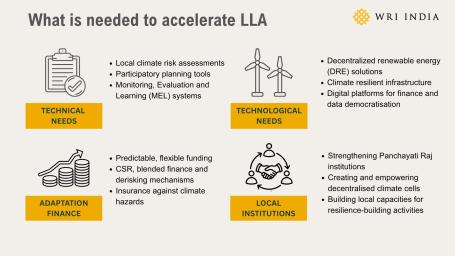
Ensuring the implementation of LLA at scale requires bridging technical, financial and institutional gaps across public institutions, communities and the private sector.
National and subnational governments, as well as other policy actors in India, are increasingly recognising climate change as a developmental challenge and are shaping strategies in response. The National and State Action Plans on Climate Change outline sector-specific approaches to mitigation and adaptation within their respective jurisdictions. Yet moving from strategy to sustained, locally grounded action requires converging capacities across government, the private sector and local communities. Without such alignment, bottom-up adaptation efforts risk remaining fragmented and short-lived. This raises an important question: how can locally led adaptation be embedded within existing systems?
Bridging the Gap Between Planning and Practice
Although India's governance structure encourages bottom-up decision-making, funds continue to flow top-down, and development priorities remain poorly aligned across levels. Climate action, particularly adaptation, often takes a backseat as governments prioritise immediate development pressures.
Siloed strategies across ministries and departments, scarce financing mechanisms for LLA, and limited institutional capacity for implementation hinder the mainstreaming of LLA. Bridging these gaps requires clearer mandates for resilience-building, greater coordination across departments and stronger institutional accountability.
Furthermore, policymakers can leverage existing pathways to institutionalise and implement LLA beyond scattered pilots. District-level plans and Gram Panchayat Development Plans (GPDPs) can serve as viable entry points. Gram Sabhas can aggregate community priorities and create opportunities to integrate adaptation into mainstream development planning. By moving beyond consultation and participatory processes, decentralized planning can give communities real authority to design place-based adaptation strategies.
Sustained trust requires behavioural change, capacity-building and long-term engagement with communities within their local contexts. This can be achieved by addressing intersectional vulnerabilities, ensuring inclusive participation, combining local knowledge with science, and using cultural mediums, such as street plays, for climate communication and leveraging indigenous knowledge for nature-based solutions in development programs.
But institutional reform alone is insufficient. LLA requires sustained financing. Governments can finance climate action by converging funds from multiple departments (such as water, agriculture and fisheries) and leveraging schemes and missions (such as rural and urban livelihood missions, skill development missions, Swachh Bharat Mission and Jal Jeevan Mission).
The Climate Resilient Village Model
The Climate Resilient Villages (CRV) program under the Tamil Nadu Climate Change Mission (TNCCM) exemplifies LLA. Under CRV, place-based approaches are helping build adaptive capacity through locally planned and managed interventions in climate-vulnerable and socio-economically marginalised villages. Such approaches also inform policy decisions by tracking outcomes, including carbon sequestration.
In Killai, Cuddalore, WRI India supported a pilot project that is training social enterprises under the National Rural Livelihoods Mission (NRLM) to recycle and upcycle glass waste collected at tourist locations.
Assessments and discussions with local authorities revealed that a high quantum of glass waste is generated from heavy tourist footfall in Killai. The authorities reported a need for alternate strategies to deal with glass waste after segregation, since their current Material Recovery Facility (MRF) did not have sufficient capacity. Meanwhile, the tribal women employed at the facility were mainly engaged in waste collection, segregation and vermicomposting, with no revenue model in place through re/upcycling of segregated waste streams.
WRI India spoke with communities and local authorities to arrive at a solution and connected them with a local Community Based Organisation (CBO). The CBO now builds the technical capacity of the women currently engaged at the MRF by sharing expertise on processing segregated glass waste. Depending on volumes and feasibility, the glass is either recycled and procured by glass factories or upcycled into handicrafts for sale in tourist spots. This has contributed to income resilience for local women, circular and local value chains and created new opportunities for resource mobilisation for the panchayat.
Operationalising LLA cannot follow a one-size-fits-all approach. Its success lies in adapting interventions to local contexts, empowering local institutions and bridging capacities across sectors. Policymakers are increasingly recognizing locally led adaptation as a pathway to not just climate resilience, but, significantly, to inclusive and sustainable development for all.
Technocratic approaches to development have often overshadowed local knowledge systems. For LLA to remain true to its ethos, place-based strategies must embed a sense of history, belonging and community knowledge. Institutional coordination among departments, with clear mandates and accountability, alongside behavioural change and environmental education for community stewardship, is essential. Mobilizing private sector investment through corporate social responsibility, in addition to better development finance convergence, can further strengthen implementation.