


Marine Decarbonisation: From Global Trade to Green Seas
Did you know that without ships, 8 out of 10 everyday goods would not reach you? Maritime transport underpins the global economy, carrying over 80% of global trade and enabling the movement of essential commodities, manufactured goods and energy resources.
Shipping currently accounts for nearly 3% of global GHG emissions, and if left unchecked, this could rise sharply to about 17% by 2050. Approximately 86% of emissions are concentrated in just five vessel categories: container ships, bulk carriers, tankers, general cargo ships, and gas carriers. This leaves the entire rest of the fleet, such as ferries, cruise ships, fishing vessels and others, as a marginal contributor by comparison.
In response to growing emissions, the International Maritime Organization (IMO), the global regulatory body for shipping, adopted its revised Greenhouse Gas (GHG) Strategy in 2023, setting a pathway toward net-zero emissions by 2050. In April 2025, the IMO approved the draft Net-Zero Framework, a critical component of its strategy that outlines detailed regulatory measures to tackle lifecycle emissions from international shipping. In addition, green shipping corridors, which are specific trade routes designed for low or zero-emission operations, are emerging as collaborative platforms to test, demonstrate and scale new decarbonisation pathways. Together, these efforts are boosting investment and interest in alternative marine fuels such as green ammonia, methanol and hydrogen, which offer some of the most viable pathways to deep emissions reduction.
This blog explores how these global shifts are redefining marine decarbonisation and what India must do to prepare its international fleet.
Global Regulatory Push
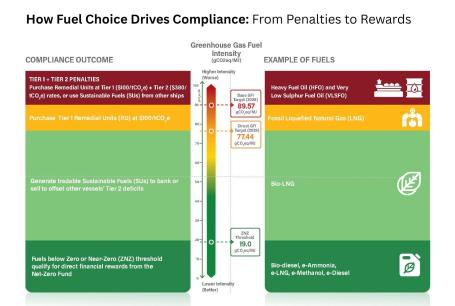
The IMO’s draft Net-Zero Framework establishes mandatory Greenhouse Gas Fuel Intensity (GFI) standards to limit emissions per unit of energy used. It uses a two-tier penalty system based on two benchmarks: a stricter “Direct” target and a more lenient “Base” target. Fuels with carbon intensity between these two targets pay US$ 100 per tonne of emissions (considering 1 US$ = INR 88), while those exceeding the Base target pay US$ 380 per tonne. In contrast, ships using cleaner fuels that perform better than these targets earn tradable financial rewards.
The IMO will channel these penalties into the Net-Zero Fund, which will reward early adopters, support green fuel infrastructure in developing countries like India, enable technology transfer and assist vulnerable economies in their transition.
The framework, initially scheduled to be adopted in October 2025 and enforced by 2027, has now been postponed by a year due to a lack of consensus among member states. Once effective, it will apply to large ocean vessels over 5,000 gross tonnage (GT) engaged in international trade, which also account for most global shipping emissions.
What the Framework Means for India
India has significant stakes in the IMO Net-Zero Framework, with compliance costs projected at US$ 87– US$ 100 million annually by 2030, which will be paid by Indian shipowners operating foreign-going vessels. India’s shipping fleet stands at about 1,545 vessels as of December 2024. While most of India’s vessels operate along the coast, the bulk of shipping capacity lies in overseas trade. As a result, nearly 64% of the country’s international fleet, specifically bigger ships, will fall directly under these regulations.
Most large commercial vessels in India rely on heavy fuel oil (HFO), but liquefied natural gas (LNG) has been gaining traction as a lower-emission transition fuel. However, the IMO’s tightening of net-zero regulations will subject both fuels to carbon penalties, limiting their long-term viability as compliance solutions.
The infographic below maps marine fuels against IMO targets, highlighting the transition from carbon penalties to financial rewards as the transition begins.
Risks and Opportunities for India
Without timely compliance, Indian-flagged vessels risk being denied entry to ports of signatory nations, incurring higher costs due to regional measures like the European Union Emissions Trading System (EU ETS), and suffering reputational as well as competitive setbacks. These risks could disrupt India’s commodity and energy trade, increase freight costs for key imports such as crude oil, coal and fertilisers, and weaken the global competitiveness of Indian exports.
Emerging green fuels can turn this compliance burden into a strategic advantage for India. India's National Green Hydrogen Mission aims to produce up to 5 million metric tonnes (MMT) of Green Hydrogen annually by 2030, translating into 28 MMT of ammonia and 26.3 MMT of methanol, all potentially eligible for GFI rewards, as shown in the figure above. Compliance also unlocks the IMO's Net-Zero Fund, a critical support mechanism for developing countries like India. By acting decisively, India can transform regulatory pressure into an opportunity to strengthen its maritime competitiveness and leadership.
Charting the Path Forward
India has already taken significant steps toward sustainable shipping through the Maritime India Vision 2030 and Maritime Amrit Kaal Vision 2047. The country has designated the key ports as green hydrogen hubs and launched green and digital shipping corridors with Singapore and Rotterdam. The ₹25,000 crore Maritime Development Fund further aims to support this transition through long-term financing for shipbuilding, ship repair and port modernisation.
Yet most progress so far centres on domestic operations and pilots. To remain competitive in global shipping, India must decarbonise its international fleet by retrofitting high-emitting vessels, scaling green fuel production and strengthening emissions standards for new ships.
Now, more than ever, accelerating maritime decarbonisation presents an opportunity not only to reduce emissions but to strengthen India’s economic resilience and energy security. As geopolitical shifts and uncertain fuel markets reshape global trade, investing in green fuels, cleaner fleets and modernised port infrastructure can help India reduce its dependence on volatile fossil fuel imports while staying competitive internationally.