


Making Green Hydrogen Competitive: R&D Priorities to Reduce Costs
India has embarked on an ambitious journey to achieve net zero by 2070 and position itself as a global leader in clean energy. Green hydrogen (GH2) offers a promising pathway to decarbonise hard-to-abate sectors such as steel, fertiliser and refineries, among others. Recognising its potential, the Government of India launched the National Green Hydrogen Mission (NGHM) with an ambitious target to scale green hydrogen production capacity to 5 MMTPA by 2030, signalling strong political will to build this ecosystem.
As of February 2026, India's installed green hydrogen capacity stands at 8,000 TPA. This is roughly 0.2% of the NGHM target – a clear indication that the sector is still evolving. As with other emerging clean energy technologies, a critical challenge impeding the large-scale deployment of green hydrogen is high production costs. This blog looks at how R&D can bring down the cost of green hydrogen and enable its transition from pilot projects to commercially viable plants.
Factors Influencing the Cost of Green Hydrogen
Green hydrogen production cost is mainly influenced by electrolysers, Balance of Plant (BOP) components and renewable electricity. Additional expenses, such as water supply and its treatment, hydrogen storage and transportation, conversion into derivatives, and enabling infrastructure further influence the final price of GH2.
India has made noteworthy progress in driving down costs through tender-based price discovery. For example, NeuEN clinched the Oil India, Numaligarh refinery tender at INR 279/kg (GST excluded), which translates to a GH2 cost of ~US$ 3.2 per kg (considering 1 USD = INR 88). This represents significant progress but still highlights a notable cost gap with grey hydrogen, which remains at a much lower cost of US$1.5-1.6/kg in stable markets. A concerted push is needed for research and development to reduce costs across the value chain.
Leveraging R&D to Reduce Costs
The Ministry of New and Renewable Energy (MNRE) has launched a Research & Development (R&D) Scheme under the NGHM to address these cost-related challenges. Broad thematic areas under this scheme include hydrogen production, storage, compression, transportation, utilisation, testing and techno-economic analysis. The scheme is progressing, with the first round of R&D projects already awarded, and MNRE having invited a second call for proposals.
As the R&D scheme advances, there is an opportunity to further align its design and prioritisation of focus areas with near-term cost-reduction pathways to reduce green hydrogen costs across the value chain. Informed by global green hydrogen developments and stakeholder consultations, WRI India has identified key R&D priority areas as detailed below:
1. Electrolyser Materials and Supply Chain
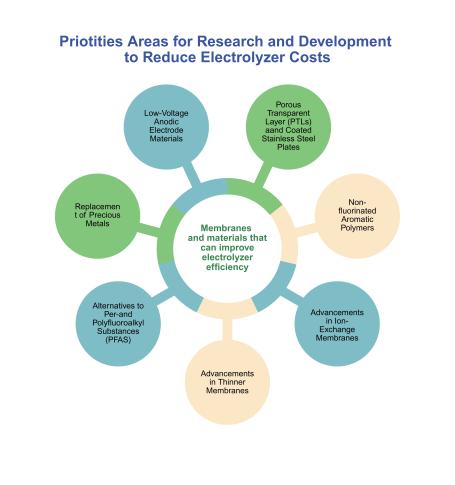
Improving the efficiency of electrolysers is crucial for lowering the energy required to produce hydrogen, which directly affects its overall cost. Research efforts should prioritise developing novel membranes and materials, targeting alternatives to critical minerals and precious metals. India currently imports these in large quantities. Further research into innovative electrode designs is also essential, as they can enhance efficiency by reducing cell voltage and increasing current density. Parallel research on safety measures to mitigate gas crossover and operational risks is also needed.
Advancements in material science, cost-effective manufacturing and improved system integration should remain key areas of research focus. Focused R&D is also needed to identify and optimise stack materials that not only reduce costs but also meet demand criteria for durability, lifespan and recyclability.
2. Power Electronics and Balance of Plant (BoP)
India’s strong electronics design and manufacturing capabilities, particularly in power converters, thyristors and Insulated Gate Bipolar Transistors (IGBTs), should be harnessed for local innovation. With power electronics and BoP components comprising up to half of an electrolyser plant’s CAPEX, building on domestic strengths will be key.
MSME-driven technology clusters should also be promoted to focus on compressor design, membrane and catalyst manufacturing, and the development of power converters tailored for electrolysis plants.
3. System-level Innovations
System-level innovations in areas like sensors, ultrasonic diagnostics, bipolar membrane electrolysis, digital twins for plant management, etc., enable real-time optimisation, quality control across diverse hydrogen use cases, and significant improvements in performance, safety and scalability. Pursuing these priorities enhances overall plant efficiency, which directly cuts operational and maintenance costs through reduced downtime, optimised energy use and predictive maintenance.
The Path Forward
Bringing down green hydrogen costs to boost commercial viability calls for innovation across the entire value chain. To accelerate the development and deployment of green hydrogen R&D in India, lessons from the Innovations for Defence Excellence (iDEX) and the Defence Advanced Research Projects Agency (DARPA) models can be particularly instructive. The design principles embedded in these models — challenge-led programmes, empowered programme management, and iterative lab-to-field prototyping — offer relevant insights for structuring green hydrogen R&D in India. Aligning research with deployment pathways and explicit cost-reduction milestones could enable accelerated learning and scale-oriented innovation.
By connecting cost-reduction targets, enabling ease of doing R&D, fast-tracking startups, and prioritising risk-tolerant and high-impact research, India can position itself as a global leader in green hydrogen technology and accelerate its decarbonisation journey.