


Interview: Can Games Be “Serious” Climate Tools?
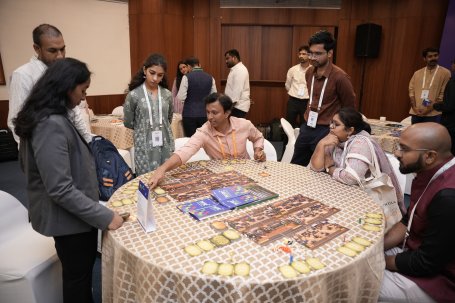
Connect Karo 2026 brought together a game room experience where we platformed board games, card games and gamified planning tools to help people understand and navigate various aspects of the climate crisis. Inspired by WRI India’s work, these games brought people together in an unprecedented way and sparked easy conversations on serious subjects.
Amid the games that were platformed was Factory Floor, a board game built by Aashutosh Mule – a game designer and sustainability educator based in Mumbai. His professional work spans education, design and systems thinking, with a focus on making complex ideas more accessible through experiential and participatory approaches. We sat down with Aashutosh to explore “serious games” or gaming for social good from his experience and perspective. The following are edited excerpts from the conversation.
Aditi: Can you tell us a little about Factory Floor?
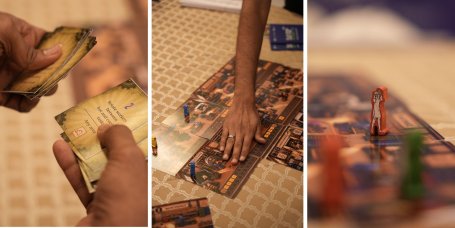
Aashutosh: Factory Floor looks at the heat challenges workers face in a typical micro, small or medium enterprise (MSME) in India and how they can be addressed. Different areas in the factory floor – production, boiler and storage – have varying heat thresholds. The game uses heat incident cards that increase heat, and action cards that address heat risks. The goal is to take collective actions to build heat resilience before heat levels reach a critical threshold – if the heat threshold in any two areas is crossed, you lose. Players win when they cooperate to permanently remove heat blocks from three areas.
The game designing underwent iterative stages. The first prototype called ‘Silsila Loo Ka,’ (chronicles of hot, summer wind) comprised textile manufacturing units in 4 villages represented by dices where players had to increase the productivity of the textile mills amidst heat challenges. Players enjoyed the game, but I wondered if the game is doing what I intended it to do?
If heat challenges are specific to the different areas on the factory floor, then I needed to take the players inside the factory, and onto the factory floor. The current version of the game is about running from one area to the other with players collaborating and strategising heat resilience interventions to save the day.
Aditi: Why did you select such a specific, and somewhat niche topic to build a board game and what was the thought process and intention behind it?
Aashutosh: I was attending a board game designing workshop, by the end of which, each participant had to build a new game. We were asked to choose from five sustainability themes for the game. Incidentally, I had read an article authored by two WRI India experts, Bhawna Ahuja and Ananya Chakraborty, which detailed the heat challenges faced by MSME workers, the practical nuances of why current solutions do not work, and what low-cost measures could be implemented.
It was based on a 3-year study by the institute on climate risks of MSME units across the country. I made the game for a workshop and then reached out to the authors. They were delighted and mentioned the challenges in bringing about awareness on such issues and how something like this could actually go a long way in capacity-building. That's when we started building the game. I also realised that it was a market gap that could be addressed and was a good area to channelise my own inter-disciplinary interests.
Aditi: When you designed the game, who did you imagine it being for and how do you plan on taking this ahead now?
Aashutosh: Initially, I was very clear that the game that I am designing is for MSME owners and workers. The game is intended to be played by them, but they are not the stakeholders who would buy the game. Instead, I see organisations that are supporting MSMEs as the ones investing in the game for capacity-building. NGOs or think tanks might facilitate the game among the MSME workers and owners for raising awareness.
From what I read in the article, there are low-cost heat resilience measures that have been successfully implemented in certain units, but there is not a lot of awareness about this. So, I wanted the game to focus on the solutions. The heat event cards in the game don't really elaborate on what these events are, because that is not the point. As we play the game, it is about implementing the short-term and long-term solutions as you move from one area of the factory floor to the other, and the urgency of the heat stress. So, I hoped the game would act as a primer for people.
Aditi: And what has the response to the game been like so far?
Aashutosh: I constantly keep on learning ways in which games can be made more fun to play or increase its replay value. You try and toss in a few game mechanics into it, so it is a fun experience. But in the sustainability sector you are often designing games for people in rural setups, farmers, construction workers or taxi drivers. An audience that may not be used to playing games. So, adding mechanics comes at the cost of making the game overwhelming for them for them to play. This has been a new learning for me as I developed the game with WRI India. While I had to keep the game simple, and I could have simply settled with that, I took it as a challenge to not lose out on the fun factor. As I took out one game mechanic after another, I was worried if the game would really be fun, but players have reported enjoying the game while also learning about the heat solutions. I could not have asked for more.
Aditi: Could you talk a little about what are “serious games” and what role do you think they can play in tackling the climate challenge?
Aashutosh: Serious games are basically games whose primary purpose is not entertainment. They are built for capacity-building, for awareness or for behaviour shifts. A game can make complete strangers interact with one other, compete or cooperate, and by the end of it there is an easy, open channel of communication. The ice is broken. So, I see games as a low-stakes platform for people to interact and connect.
Secondly, games can be very immersive. I have played games where I can't even afford to take out my mobile and check my messages because if I do that, I might lose out. Games can keep you engaged with the board for hours together almost in a state of elevated focus.
Serious games, however, are designed to bring out prosocial behaviour. For instance, my first game Silsila Loo Ka was a competitive game where the goal was increasing the productivity of the mill despite heat. When I tested it, I saw players saying that, okay, in this round, let’s kill some workers to increase productivity. And I thought, wait a minute, what's happening? Because I wanted the game to centre empathy and not short-term thinking. So, in games like this, which are tackling climate issues, the goal of the game should be in sync with what you want to achieve. Rather than competitive games, I believe games about the climate challenge should be cooperative, because that is what we need, and that is what works.
I have a background in biophysics, so I have always had an interest in neuroscience. There are ecological reasons as to why we behave a certain way in certain social conditions. And a game gives you the creative freedom to create the conditions that make people act a certain way. I believe this is very important when it comes to sustainability challenges and bringing out prosocial behaviours.
Aditi: Could you tell us a bit more about some of the other games you have worked on?
Aashutosh: There's another game that I am working on called Ki. Ki is what you call a dog in Ladakh. The game focuses on how unsustainable human actions impact the behaviour of animals. In the game itself, players manage an eatery and try not to let the food go to waste. Overflowing bins lead to chaos among dogs, and the player’s job is to avoid that.
The idea is based on how tourism in Ladakh has seen a sharp uptick in the last 2 decades, and a lot of roadside eateries have sprung up to cater to this rise. Most such places overproduce food and the leftovers get dumped. Stray dogs depend on these food dumps, but with the arrival of harsh winters in Ladakh, tourism curbs abruptly.
The dogs that are dependent on the food waste cannot anticipate this. One day they have their fill, and the next day there is nothing. This has become a menace in Ladakh, with reported cases of dogs attacking livestock and even humans. And it is not always for food; the issue is complex. Any domestic animal was once wild, and domestication has a very delicate equilibrium that is impacted by human actions. So, the game puts the focus on these specific human actions and gamifies it.
Aditi: If we look ahead ten years, what does a truly 'sustainable' game studio look like to you, and what will it mean for organizations, like WRI India, that are working in the sustainability space?
Aashutosh: Organisations like WRI India generate research, develop solutions, inform policy and work with stakeholders to address sustainability challenges. However, there can be a gap between making people aware of a problem and motivating them to understand, engage with and act on possible solutions. This gap may be particularly pronounced at the community level, where information alone may not be enough to inspire participation or action. People need opportunities to relate these challenges to their own lives, explore possibilities, understand trade-offs and experience a sense of agency.
A sustainable game studio can be a complementary force that helps bridge this gap. It can complement sustainability efforts through the power of play, storytelling and experiential learning to make knowledge more accessible, engaging and actionable. A well-designed game doesn't merely tell people what they should do; it allows them to experience why certain choices matter.
Ultimately, I would like to see a studio whose success is measured not just by the games it creates or the revenue it generates, but by its ability to bridge the gap between knowledge and engagement, to translate awareness into meaningful action.