


How Cities Can Reshape India’s Care Economy
Consider what it takes to nurture and sustain everyday life. In your own home, this might include cooking, cleaning, feeding, teaching, counselling or running errands. These are not just acts of love or duty — care is essential, productive labour.
In India, unpaid care work is estimated to account for nearly one-sixth of GDP, yet it remains largely invisible and undervalued. Both paid and unpaid care work is disproportionately carried out by women and girls. A recent Supreme Court judgement recognising the contribution of homemakers in nation building marks a positive step in visibilising the value of care work.
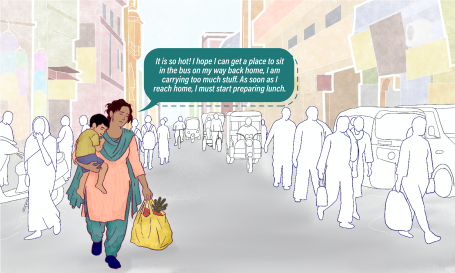
India’s care economy, estimated at about $300 billion, has the potential to generate over 60 million jobs across life-stage care, health, recovery and inclusive support services. As cities grow, changing family structures, an ageing population and climate-related stresses are increasing the demand for care. Yet care is often treated as a private responsibility rather than a public concern.
What constitutes the care economy?
As per the International Labour Organization, care economy encompasses care work — paid and unpaid, direct and indirect — delivered through the public and private sectors, including MSMEs, non-profit organizations, the social and solidarity economy and households. Learn more here.
Instead, care must be understood as something shaped and enabled by the urban environment. Cities have a critical role to play in reducing care burdens, expanding access to essential services and creating the conditions for more equitable communities. But what does investing in care look like?
Below are four ways cities can support and reshape the care economy through inclusive and resilient urban development.
Cities that Serve Women Caregivers
How can we rethink cities through the eyes of women caregivers? Read here.
Integrate Gender Equity in Urban Planning
Research indicates that for each additional hour of caregiving per day, women’s participation in the labour market reduces by 20%. While women in Indian cities rely on public transport for 84% of their trips, safety concerns, unreliable services and poor infrastructure further restrict their mobility and economic opportunities.
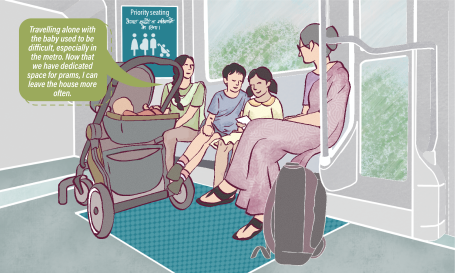
When cities adopt gender-inclusive design, they strengthen local institutions, increase women’s participation in local governance and support more equitable growth. This can look like Kerala’s gender-responsive planning approach, which reserves 10% of urban funds for women-focused projects like shaded walkways — since women caregivers rely heavily on walking — and accessible childcare.
Improve Access to High-Quality and Safe, Care-enabling Social Infrastructure
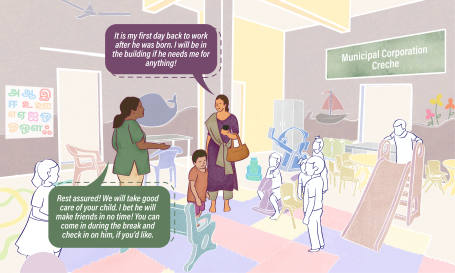
In 2025, Indian women’s labour force participation in urban areas was only 27.7% compared with 76.2% for men. More than half of the women surveyed cited childcare, homemaking commitments and time poverty as a key reason for staying out of the workforce. Access to childcare can help women work more productively or shift to more desirable work, which improves women’s overall economic agency.
Cities can ease these constraints by investing in networks of social infrastructure, including Anganwadis, Primary Health Centres, creche, community centres and parks. When these services are safe, easily accessible from homes and workplaces, and well maintained, caregivers spend less time and energy meeting daily care needs. Additionally, clustered, multi-use facilities, shared spaces for caregivers, supervised play areas and programmes that engage fathers can help families and communities share caregiving responsibilities more evenly.
Create a Care-friendly Public Realm
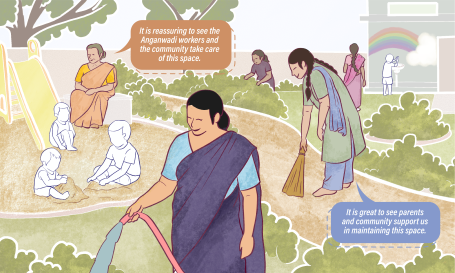
Public spaces shaped by women, youth and marginalised groups are more likely to become "dividend multipliers," by strengthening social connections, supporting commerce and building community resilience.
Experiences from the Nurturing Neighbourhoods initiative illustrate this potential. In Kochi and Pune, locally led activities in parks and public spaces have brought parents and caregivers together, creating informal support networks and a stronger sense of belonging. In Jaipur and Bhubaneswar, adolescents have emerged as stewards of public space transformation, improving accessibility and safety, particularly for girls and young women.
By extending care beyond the home into neighbourhoods, care-friendly public spaces foster shared responsibility, strengthen community support systems and build more resilient, inclusive cities. They also create opportunities for care-based livelihoods and local enterprise, reinforcing the care economy while making cities more liveable for everyone.
Promote Care-based Livelihoods
Investing in the care economy can generate jobs while creating livelihoods that help cities function and thrive. Care-based livelihoods include nursing, teaching, domestic work, childcare and home-based care, as well as services that support liveable neighbourhoods, including food vendors, sanitation workers, learning centres and micro-enterprises.
New models of care-linked entrepreneurship are emerging that combine income generation with neighbourhood care. Many women’s self-help groups run childcare cooperatives alongside catering or retail and local repair services for housing contribute to better water, sanitation and hygiene (WASH) infrastructure. Greening and public space initiatives by youth-led groups also contribute to the community while enabling a sense of ownership.
Yet, most care workers are women in informal or semi-formal roles without contracts, social security or safe conditions. By setting safety standards, enforcing minimum wage standards, and integrating training into national skilling missions (highlighted in the 2026 Budget), cities can upgrade these roles into dignified urban livelihoods. Career pathways, performance-linked incentives and digital tools can further improve productivity and working conditions for frontline care workers. This can lead to better health, education and social outcomes, along with thousands of new, stable livelihoods that help sustain resilient neighbourhoods.
India’s urban future hinges on recognising care work as a strategic pathway to economic growth. The International Labour Organization’s 5R Framework — recognise, reduce, redistribute unpaid care work, and reward and represent paid care work — offers a clear roadmap to advance gender equality while enabling dignified, productive livelihoods.
Building a “care web” through social infrastructure, inclusive public spaces, decent livelihoods and gender-responsive planning can make cities more inclusive, resilient and better prepared for a future that serves everyone.
All graphics are by Arundhati Hakhu and Astha Sharma/WRI India, unless mentioned otherwise.
