

Union Minister Shri G. Kishan Reddy Outlines National Priorities to Strengthen India’s Battery Ecosystem at Battery Summit 2026
New Delhi, June 16, 2026: Shri G. Kishan Reddy, Hon’ble Union Minister of Coal and Mines, highlighted the pivotal role of batteries in driving India’s net-zero transition and advancing the vision of Viksit Bharat by 2047 at the Battery Summit today. He emphasised the need to build a self-reliant, sustainable, and globally competitive battery ecosystem to support the country’s long-term economic and industrial growth ambitions.
Inaugurating the Battery Summit, Shri G. Kishan Reddy, said, “India has already taken a series of bold and forward-looking decisions to secure our clean energy future under the visionary leadership of Hon’ble PM Shri Narendra Modi ji. The next phase of this journey requires a resilient battery ecosystem that will depend on how effectively India secures critical minerals while strengthening its domestic manufacturing capabilities. Strategic partnerships and investments driven by forward-looking policies will be essential to unlocking the true potential of this transition.”
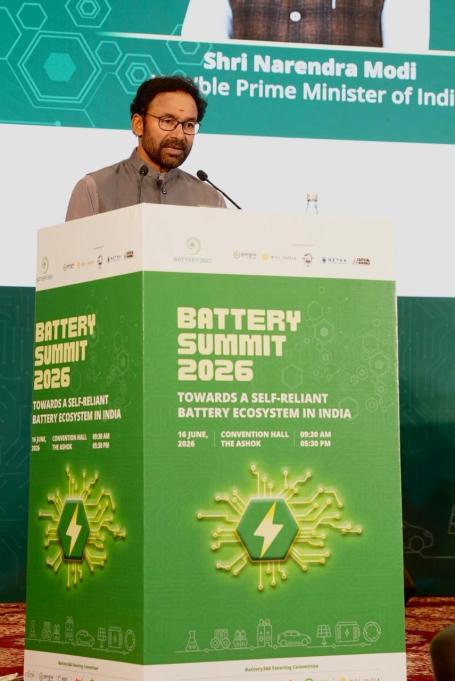
He added, “To support this vision, more than 570 critical mineral exploration projects have been taken up across the country, and 46 critical mineral blocks have been auctioned since 2015, including 22 in the last one-and-a-half years alone. India has also secured lithium assets in Argentina as part of its efforts to build resilient global supply chains for critical minerals.
Convened by Battery360 in partnership with WRI India, Energiva Ventures, International Advanced Research Centre for Powder Metallurgy and New Materials (ARCI), the New Energy Technology Research Alliance (NETRA), and the Critical Minerals Association (India), the Summit brought together senior government officials, industry leaders, financiers, and innovators to chart the path forward for India’s battery-led clean technology transition.
India’s annual requirement for lithium-ion battery (LIB) variants is projected to rise sharply from 20 GWh in 2022 to 220 GWh by 2030, reflecting a robust compound annual growth rate (CAGR) of 50 percent. Currently, the country remains heavily reliant on imports to meet this demand, with LIB imports increasing from $1.2 billion in 2018-19 to $4.7 billion in 2025-26.
Against this backdrop, the Summit underscored the urgent need to expand domestic manufacturing, strengthen critical mineral supply chains, and create enabling conditions for innovation and investment. Shedding light on India’s investments in research and development and circularity, Shri G. Kishan Reddy, said, “We are strengthening the innovation ecosystem through the establishment of nine Centres of Excellence focused on critical minerals and advanced technologies. At the same time, four Critical Mineral Processing Parks are being developed to enhance domestic value addition and reduce import dependence. The Government has also approved a Rs 1,500 crore Critical Mineral Recycling Incentive Scheme to promote circularity and resource security.”
At the Summit, speakers also emphasised the importance of policy coherence across industrial strategy, mineral partnerships, and sustainability frameworks, along with faster implementation pathways and stronger private sector participation.
The Summit also saw the signing of an MoU between WRI India and IIT Roorkee to foster collaboration in areas related to battery innovation, research, and knowledge sharing.
Speaking at the plenary, Madhav Pai, CEO, WRI India, said, “Battery360 has created a shared national platform that brings together policy, industry, and innovation ecosystems around a common goal of building self-reliance to power India’s clean energy transition. Unlocking the full potential of India’s battery value chain will require coordinated action that brings policy ambition, investment priorities, and technological innovation into alignment.”
Sachin Kumar, Vice President, Energiva Ventures, said, “The next phase of India’s clean energy transition will depend on our innovation with the right mix of capital, policy support, and industry partnerships. From early-stage technologies to scalable commercial solutions, the opportunity lies in building an ecosystem where startups and established players can together accelerate India’s net-zero transition.”
Innovation Showcase and Report Launches
The Hon’ble Minister also inaugurated the Battery Technologies Showcase, that brought together 20+ Indian startups and innovators showcasing cutting-edge solutions spanning advanced chemistries, energy storage systems, battery management and recycling. Many of these innovations were identified through 360 Ignite, a nationwide initiative undertaken in partnership with IIT Delhi and IISc Bengaluru, aimed at discovering high-potential startups that are addressing gaps across materials, cell technologies, second-life applications, and end-of-life solutions.
The Summit also saw the launch of several reports, each addressing critical challenges, opportunities and priorities for India’s rapidly growing battery ecosystem:
- Battery Aadhaar: Scope and Use Case Report by Battery360 — explores key use cases, implementation challenges, and recommendations for advancing battery traceability in India.
- Battery Aadhaar for India: Potential Pathways for a Domestic Battery Data Management Framework by WRI India — discusses data governance, technology systems, regulatory requirements, stakeholder coordination, and business models needed to build an interoperable, secure, and scalable Battery Aadhaar for India’s clean energy transition.
- States in the Driver’s Seat: Policies Localizing Electric Vehicle and Battery Manufacturing in India by the International Institute for Sustainable Development (IISD) — examines how state policies are supporting the localisation of EV and battery manufacturing.
About WRI India
WRI India, an independent knowledge organisation registered as India Resources Trust, provides objective information and practical proposals to foster environmentally sound and socially equitable development. Through research, analysis, and recommendations, WRI India puts ideas into action to build transformative solutions to protect the earth, promote livelihoods, and enhance human well-being. Know more: wri-india.org
Media Contact
Ankita Saxena | [email protected]
Satbhan Singh | [email protected]
