

Accelerating Clean Energy 2026 Calls for Stronger Collaboration to Drive India's Energy Transition
IIT Bombay and WRI India convene 500+ participants across academia, policy, industry and finance to chart pathways for a resilient, inclusive clean energy future
Mumbai, 24 June 2026: With India facing the twin pressures of a warming climate and rising energy demand, the urgency to accelerate the clean energy transition has never been greater. Accelerating Clean Energy 2026 (ACE 2026) brought together key stakeholders to advance solutions for a faster and more inclusive transition, grounded in the understanding that progress depends on stronger collaboration across research, policy, finance and technology.
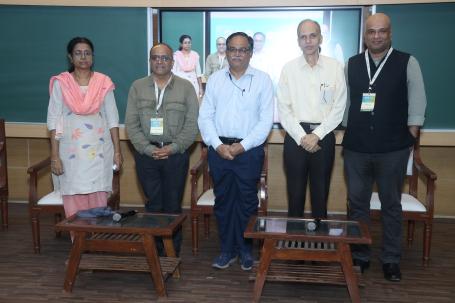
Held at IIT Bombay on 23-24 June 2026, the two-day conference convened more than 500 participants from close to 50 organisations across the country. Discussions centred on the infrastructure, policy, financing and technology priorities needed to build a resilient and inclusive energy future for India. Jointly organised by the Research Hub for Green Energy and Sustainability (GESH IITB) at IIT Bombay and WRI India, the forum brought together academics, policymakers, industry leaders, regulators, researchers, startups and experts to explore practical pathways for accelerating clean energy deployment and strengthening energy systems.
Opening remarks were delivered by Prof. Shireesh Kedare, Director, IIT Bombay; Bharath Jairaj, Executive Program Director, Energy, WRI India; Prof. SV Kulkarni, Dean, Research and Development, IIT Bombay; and Prof. Bakul Rao, Head of Department, Centre for Technology Alternatives for Rural Areas, IIT Bombay.
Prof. Shireesh Kedare, Director, IIT Bombay said, “We need to work on integrated strategic research that goes beyond individual projects. Are we geared up organisationally for it? That is a big question mark. Educational institutions, industry and research organisations need to think differently if they are to address future challenges. Climate change is an extremely challenging problem that must be tackled at the individual, community, institutional, national and global levels. We all need to think about what we can do and experiment with new ways of addressing these challenges."
Bharath Jairaj, Executive Program Director, Energy, WRI India, said, "ACE 2026 demonstrated what becomes possible when research and practice converge. Our partnership with the Green Energy Sustainability Hub at IIT Bombay brought together peer-reviewed inquiry and cross-sector dialogue across infrastructure readiness, demand transformation and distributed systems, examining the technical, institutional, financial and material conditions that India's energy transition demands. This is exactly the kind of collaboration our clean energy future needs."
The inaugural session set the tone for the convening, with speakers underscoring the urgency of coordinated action to meet India's clean energy goals.
Sessions at ACE 2026 were organised around one central question: as demand accelerates and renewable penetration rises, what must hold for India's energy transition to scale reliably? The conference received an overwhelming response to its call for abstracts and poster presentations, with close to 100 submissions spanning three thematic tracks: Infrastructure Readiness and System Reliability; Demand and Load Transformation; and Innovations in Distributed and Hybrid Systems.
Ajay Shankar, Distinguished Fellow, The Energy and Resources Institute (TERI), who delivered the keynote address, said, "This conference has been an enriching experience covering the full range of key issues and challenges with cross-cutting technical, policy and practical experience and expertise."
Padma Shri Prof. Juzer Vasi, Professor Emeritus, IIT Bombay, reflected on the rapidly evolving research landscape over the last decade in both photovoltaics and semiconductors, noting the pivotal role this progress has played in strengthening India's capabilities in renewable energy technologies. He underscored the need for sustained investment in R&D for solar manufacturing for India to get ahead of the curve, particularly given the geopolitical fractures that have formed over the last five years, and to achieve its energy transition goals.
About WRI India
WRI India, an independent knowledge organisation registered as India Resources Trust, provides objective information and practical proposals to foster environmentally sound and socially equitable development. Through research, analysis and recommendations, WRI India puts ideas into action to build transformative solutions to protect the earth, promote livelihoods and enhance human well-being. Know more: wri-india.org
About GESH IIT Bombay
The Green Energy and Sustainability Research Hub at IIT Bombay is a pioneering centre dedicated to addressing the global climate crisis by facilitating technological, management & policy solutions through research in green energy and sustainability domains. We envision bridging the gap between academic research and real-world application while fostering education and entrepreneurship in these critical fields. We aim to nurture the next generation of green energy and sustainability leaders to tackle complex environmental challenges from multiple angles, promoting creativity and innovation. GESH IITB will be the first point of contact for green energy and sustainability research, education and other services at IITB.
Media Contacts
Shivani Shah | [email protected]
Vaibhav Pahel | [email protected]
Dr. Vijayasree Sunoj | [email protected]