


Women on the Move: Exploring the Gendered Realities of Bengaluru’s Namma Metro
In August 2025, Bengaluru’s Namma Metro recorded its highest-ever single-day ridership of over 1 million passengers. This milestone came shortly after the launch of the long-awaited Yellow Line, which connects the city with its leading tech hub, Electronic City. The second-largest metro network in India, after Delhi, Namma Metro currently spans 96 kilometers and 83 stations with a plan to extend to another 80 km by December 2027.
As this expansion takes place, a key question emerges: is there a gender gap in metro planning? Improving metro ridership by ensuring that women are not left out of the system – alongside enhancing other public transport solutions – is a high impact intervention that can ease Bengaluru’s infamous traffic congestion, reduce pollution, and encourage sustainable mobility and access to opportunity.
Do Women Travel Differently?
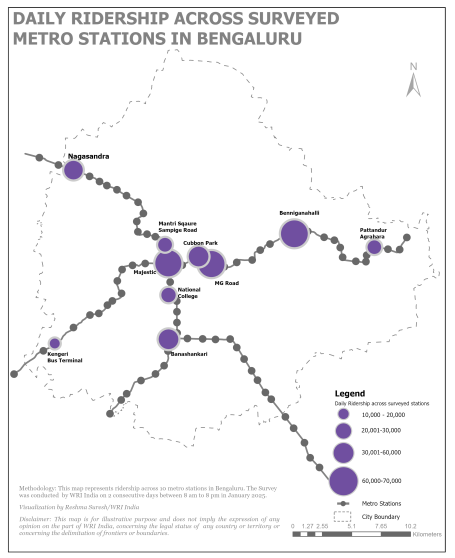
Are women and men using the Namma Metro in equal numbers? Do ridership patterns differ significantly by time of day or station? Amidst limited disaggregated data available to study these patterns, we manually counted the male and female passengers at 10 metro stations across Bengaluru over two consecutive days, from 8:00 am to 8:00 pm. The selected stations had a mix of high and medium ridership, linked to different parts of the city’s land use, including interchange, government and private office hubs, and residential neighborhoods.
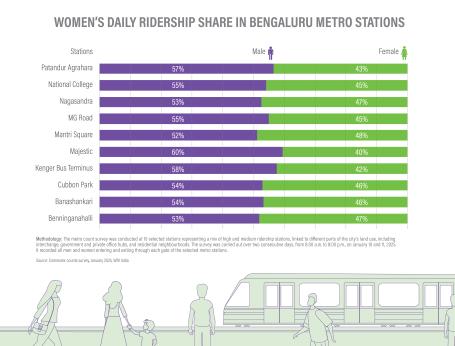
Across the sampled stations, women accounted for 45% of commuters. This average masks significant station-level and time-of-day variations. Stations like Mantri Square (48%) and Benniganahalli (47%) see higher female ridership. In contrast, key transit hubs such as Majestic (40%) and Kengeri Bus Terminus (42%) record lower female ridership.
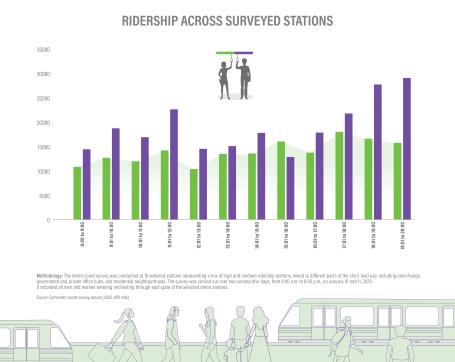
The overall ridership across the selected stations remains relatively steady within female commuters across all hours and is higher in the morning and evening hours for men, however, a closer look at station level ridership reveals a varying pattern.
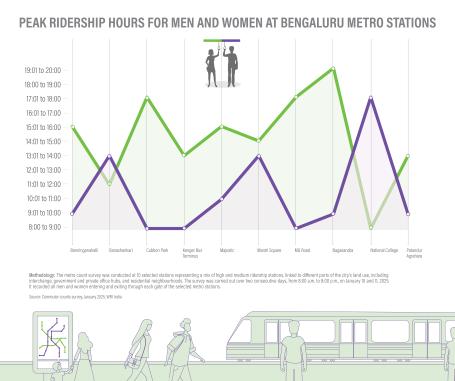
But station level ridership patterns reveal that men’s travel peaks between 8-10 am and 5-7 pm, while women’s travel varies between mid-morning to early afternoon. Unlike men, women’s commuting patterns are dispersed throughout the day.
Going Beyond Expansion to Ensure Equitable Access
Studies reflect similar findings as those observed by us at the stations in Bengaluru. Unlike men, women’s travel patterns are typically spread throughout the day, particularly during the mid-day and early evening hours. These off-peak journeys are often tied to caregiving responsibilities (also known as ‘Mobility of Care’), informal or flexible employment, and multi-purpose trip chains that differ significantly from the traditional, peak-hour commutes associated with full-time work.
However, most public transport systems reduce service frequency during non-peak periods. This mismatch between service design and actual travel behavior constrains women's mobility, reinforcing systemic barriers to access and opportunity. Furthermore, concerns about safety, caregiving duties and limited time, result in women paying disproportionately more than men for last-mile travel.
Commuters who rely on a weekly metro pass (5-day pass) spend approximately ₹41,600 annually but unreliable last-mile connectivity compounds these costs, particularly for women. Women often find themselves compelled to take costlier solo autos due to the lack of safe alternatives, while men are more likely to walk or share rides. For commuters living in distant or poorly connected areas, it is harder and costlier to reach the station. Without safe parking or adequate feeder services, many women are left out of the system. Moreover, while men often use private vehicles to drive to the metro station, lower vehicle ownership rates among women further limit their station access.
The Gendered Impact of Overcrowding
The metro’s success has also surfaced capacity concerns even as Bengaluru Metro Rail Corporation Limited (BMRCL) added loop trains between hubs. Media reports have highlighted overcrowding, with passengers waiting through multiple train cycles to board and long queues spilling beyond platforms.
Even when not a hazard, overcrowding can have gendered implications, bringing with it the risk of sexual harassment and physical discomfort. Navigating crowded coaches while juggling caregiving responsibilities is another challenge. Women also resort to the general coaches during rush hour since women’s coaches are often at the far end of the platform and have limited capacity.
What Needs to Change?
Indian transit planning still relies on static definitions of "rush hour" that prioritize peak-period commuters, typically able-bodied male workers. As mass transit networks grow, understanding the gendered patterns of mobility can unlock system-wide efficiencies for commuters, especially women. Equitable access to public transport offers women greater access to education, healthcare and opportunities, benefitting entire communities and leading to stronger economies.
Transit agencies must look at gender-disaggregated data beyond periodic snapshots. Systems that track and respond to evolving patterns, along with insights from safety audits, lived experiences and commuter feedback, can inform smarter, more inclusive service design. Agencies like Transport for London have shown how integrating gender into regular operations leads to real change: from improved off-peak services to enhanced accessibility. Technology can accelerate this shift. Smart card analytics, AI-based crowd monitoring and commuter feedback platforms offer powerful ways to surface invisible trends and adapt services in real time.
In Bengaluru, the Integrated Command and Control Centre (ICCC) shows how data can power better decision-making. By integrating live feeds from traffic systems, CCTV networks, and emergency services, the ICCC enables officials to monitor real-time conditions and act quickly. Metro agencies can build on this and make responsive planning an integral part of transit governance. Live passenger counts, crowd analytics, and commuter feedback can help identify when and where passengers face longer waits or safety concerns. Embedding such insights into daily operations can enable authorities to respond dynamically by adjusting staffing, strengthening infrastructure and adding more loop services.
As cities and metro networks expand, the demand for reliable, inclusive and affordable public transport is only going to increase. Cities like Bengaluru are at the cusp of opportunity and must look at transit planning that goes beyond infrastructure expansion to embrace mobility systems that are inclusive, safe and accessible for all.
The data presented in this blog was collected as part of the MobiliseHER project.