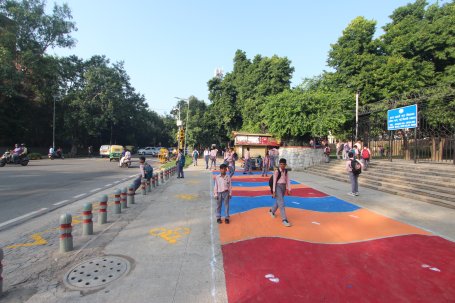

Streets That Care for Children
Every morning, a familiar scene unfolds across most Indian schools – children running between parked cars, a parent hurriedly pulling a scooter aside, a bus inching forward while drivers behind it honk impatiently.
Over 10,000 children lose their lives to road crashes every year. Children regularly navigate their way through Indian streets, yet streets are not always designed with their safety in mind. Busy roads can overwhelm children into making mistakes, and relying solely on their constant vigilance to ensure their safety is insufficient.
Unsafe Streets Limit Children’s Mobility
Safe roads and continuous pavements make it more likely that parents will allow children to walk or cycle independently to school, parks and community spaces. This independence plays a crucial role in their physical, social and cognitive development.
Unfortunately, these opportunities are often restricted by road environments that prioritise vehicles over people. Speeding traffic, distracted driving, inadequate pedestrian crossings and discontinuous footpaths can make even short journeys unsafe and increase the risk of injuries.
Moreover, children experience roads differently than adults, both physically and cognitively. Their minds and bodies are still developing, which makes tasks such as judging traffic gaps, anticipating vehicle movements or navigating visual obstructions more challenging. For children with disabilities, these barriers are even greater.
New Guidelines for Safer School Zones
Global best practices and road safety audits show how thoughtful, child-centric street design can reduce crashes. Drawing from these sources, the revised IRC SP:32 Guidelines for Safer Commute to School recognise the need to move beyond the expectation of constant vigilance from children. Instead, it offers clear, system-level improvements for safe design.
What is a school zone?
A school zone is the area around a school, including surrounding roads, streets, bus stops, intersections and parking areas, depending on the location and nature of development. These spaces experience a high concentration of child movement, especially during school opening and closing hours. Learn more in this blog.
Through measures such as structured school zoning, targeted design interventions and active community involvement, the IRC SP:32 guide lays the foundation for safer access to schools and aligns India’s efforts with national and international commitments to protect children from road traffic injuries and fatalities.
From Behaviour Change to Design Shifts
Traditionally, safety around schools focuses heavily on influencing behaviour through road safety education, signage or enforcement. But the principles outlined in IRC SP:32 shift the emphasis to design-led safety. The guidelines emphasise three core design approaches – Simplify, Shield and Cushion.
Simplify: Overburdening children and motorists with excessive information and design elements can be dangerous. The simplify approach entails reduction of elements on the road.
Shield: Road design must also prioritise distancing children from potential harm on the road. This can be done through interventions like crash barriers and reduction of conflict points using street design principles, such as geometrical corrections, continuous footpath with clear walking space, absorbing undefined areas into public spaces, etc.
Cushion: This principle acknowledges that children can make mistakes and aims to create forgiving environments that minimise harm. Traffic calming elements such as rumble strips, speed tables, wider buffers between pedestrians and traffic, protected footpaths and softer paving materials can reduce crash impact and provide drivers with more time to react, making streets safer.
These principles can be translated into a range of practical road engineering and traffic management measures within school zones.
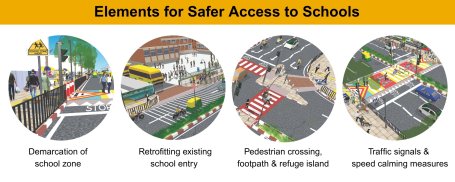
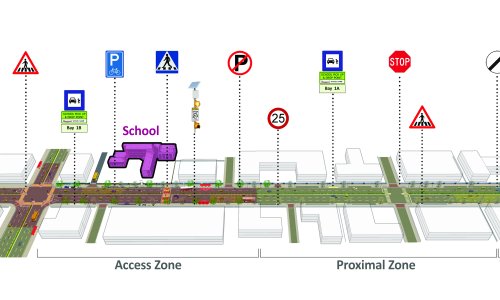
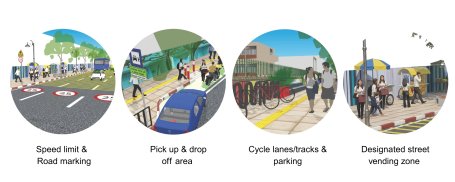
Together, these measures demonstrate how design can reduce reliance on constant vigilance from children and create environments that guide safer movement. This is not to suggest that road safety education, enforcement and parental supervision are not important. Teaching traffic rules to children and encouraging responsible behaviour among drivers remain essential components of school zone safety. However, education cannot compensate for complex or poorly designed streets.
The revised IRC SP:32 guidelines reinforce that safer outcomes emerge when education and enforcement are supported by well-designed infrastructure. By aligning street design with how children move and perceive their surroundings, these guidelines ensure that safety does not depend solely on individual behaviour.
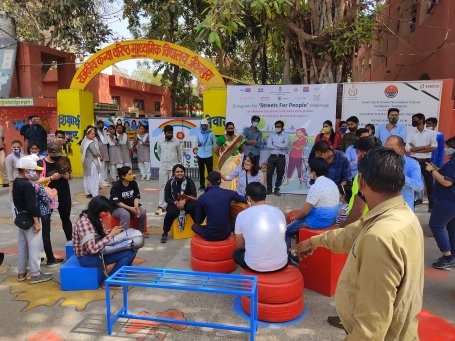
School students co-design safer, child-friendly school zones at Jacobpura, Gurugram. Photo by WRI India.
Implementing the New Guidelines
Coordinated training, data-driven audits, public–private partnerships and national funding toward scaling IRP:SC 32 can inspire nationwide adoption of child-centred road safety frameworks.
Locally, municipalities and School Management Committees (SMCs) can request a School Zone Audit from their local municipal ward, traffic police or road-owning agency. They can use the guidelines to advocate for formal pedestrian crossings, traffic calming measures, and safer walking and cycling infrastructure around schools.
At the state level, regulators can adopt the guidelines into official road safety manuals, mandate training for engineers and enforcement agencies, and monitor metrics like the number of crashes involving children. States can also introduce a ranking framework to recognise cities that successfully implement safe school zones. This can create healthy competition among cities and incentivise municipal authorities to prioritise child-friendly street design.
The national road safety bodies can also integrate IRC SP:32 into national standards, secure dedicated funding through various schemes and incentivise states to implement compliant infrastructure.
Child-centric design is often synonymous with inclusive design. By adopting and implementing these guidelines, school streets can become safer, calmer and more inclusive. Such improvements can support mobility and create accessible and vibrant public spaces that feel safe for all road users.