


Restoring Hope, Land and Livelihoods: Findings from Gadchiroli’s Opportunity Assessment
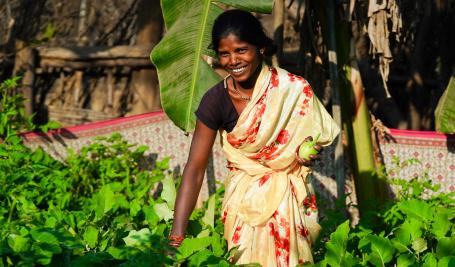
As she stacks freshly harvested tendu leaves from her village’s community forest resource (CFR) area, Laxmi describes a life shaped by uncertainty. In the Korchi block of Maharashtra’s Gadchiroli district, her family cultivates only a single kharif crop. Their fields lie fallow in the rabi season due to water stress. Income from non-timber forest produce (NTFPs) such as tendu, mahua and chironji helps bridge the gap, while her husband migrates seasonally to nearby towns for work.
A farmer doesn’t keep field fallow out of choice; water scarcity after monsoon makes it unavoidable”
- A tribal farmer from Nawrgaon village, Gadchiroli
Laxmi’s story is not unique. It reflects the lived reality of most households in this rainfed district of Vidarbha region, where livelihoods are closely tied to forests, fragile agricultural systems and increasingly unpredictable climate conditions.
Struggles Beneath the Forest Canopy
Gadchiroli holds a distinct position in the country for its recognition of forest rights under the Scheduled Tribes and Other Traditional Forest Dwellers (Recognition of Forest Rights) Act, 2006 (hereafter FRA). However, despite its rich forest cover and mineral resources, the district lags in socioeconomic indicators like nutrition, public health infrastructure and road connectivity. It also grapples with several biophysical challenges, including runoff-induced soil erosion, paddy monocropping, subsistence agriculture and low cropping intensity, since most fields only see one crop in a year due to water scarcity after the monsoons.

Together, these issues heighten the district's vulnerability to climate change and underscore the need for an integrated, inclusive and landscape-based approach that can address these.
Adapting Restoration Opportunities Assessment Methodology for Gadchiroli
WRI India, in collaboration with Food and Land Use Coalition (FOLU) India and Amhi Amchya Arogyasathi, adapted the Restoration Opportunities Assessment Methodology (ROAM) and employed a landscape-based approach to restoration in Gadchiroli district. This work builds on an earlier adaptation of ROAM in Sidhi, Madhya Pradesh, which focused on tree-based interventions. Since farming is the primary livelihood for most households in Gadchiroli, the approach was expanded to include agriculture and water resource conservation and help identify restoration opportunities and suitable interventions to support people in Laxmi’s village and build resilience to climate change within the community.
The team held community consultations with stakeholders to identify areas for restoration, priority ecosystem services, the status of enabling conditions and estimated restoration cost. We also looked at land use and ownership to identify decision-makers at different levels. This nested approach helped stitch the social, political and biophysical context at the district, block and village level.

Source: Toward ecosystem restoration and climate-resilient communities Findings from a restoration opportunities assessment in Gadchiroli, Maharashtra, India
Potential for Different Interventions
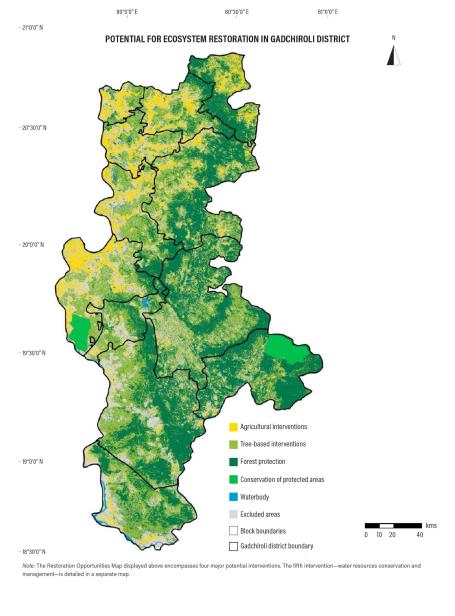
We found that, of the 1.44 million hectares of land in Gadchiroli, over 80% holds the potential for the following restoration interventions:
Source: Toward ecosystem restoration and climate-resilient communities Findings from a restoration opportunities assessment in Gadchiroli, Maharashtra, India
Conservation and management of water resources: Rejuvenation of existing water-holding structures and creation of new ones on individual farms and community land can improve water availability in the post-monsoon season.
Agricultural interventions: With availability of water Gadchiroli can raise its cropping intensity beyond the current 115% by bringing rice fallows under cultivation. At the block level, a second post-monsoon crop alone could add 61,000 tonnes of food. Interventions such as agri-horti-forestry, nutri-gardens, integrated nutrient and pest management, and water-efficient paddy practices can strengthen farmer resilience, protect fragile forest ecosystems and improve nutrition.
Tree-based interventions: Recommended for CFR areas with canopy densities lower than 40%, tree-based interventions include mixed-species plantation, bamboo rejuvenation and silvipasture development. These interventions can help improve the provision of food, fodder, fibre, fuelwood and NTFPs for communities and for wildlife.
Forest protection and conservation of protected areas: Forest areas with canopy density higher than 40%, including moderately dense and very dense forests, are recommended for protection. Conservation measures are recommended for forests within the Chaprala and Bhamragad wildlife sanctuaries.
Ecosystem service benefits from the proposed interventions: Based on secondary literature, these interventions can help strengthen three key ecosystem services: provisioning; regulating (soil and water quality and GHG regulation); and supporting (biodiversity conservation). As per our analysis, Gadchiroli’s forests have the potential to sequester nearly 70 million tonnes of additional carbon over 10–20 years.
Together, these cross-sectoral interventions aim to build farmers’ resilience, improve adaptive capacities, strengthen ecological health and diversify livelihoods.
Communities Are Central to Ecosystem Restoration
Gadchiroli is known for its community-led governance of natural resources. Our findings underscore that the success of ecosystem restoration efforts in Gadchiroli hinges on active community participation and strong local governance. With their wide network and reach, Gram Sabhas, Mahagramsabha and Self-Help Groups (SHGs) lie at the heart of decision-making, equitable benefit sharing and sustainable NTFP management.
While communities in Gadchiroli are quite familiar with widely publicized policies such as the FRA 2006, the Panchayats (Extension to the Scheduled Areas) Act, 1996, and the earlier Mahatma Gandhi National Rural Employment Guarantee Scheme, awareness of other enabling policies related to land use, restoration and climate adaptation remains limited.
To address this, ecosystem restoration priorities must be integrated into development plans at village, panchayat, block and district levels. The district administration can provide an enabling environment by offering technical support, ensuring convergence with relevant government schemes and aiding capacity-building of local institutions to sustain the benefits of restoration.
The restoration opportunity in Gadchiroli offers a rare window to achieve the long-term goals of the people-driven roadmap for Viksit Maharashtra 2047, particularly on agricultural sustainability, promoting natural farming, expanding bamboo plantations, developing agri-business and enhancing tribal welfare.
With a wealth of traditional knowledge, abundant natural resources, and strong community institutions, Gadchiroli can be the heart of ecosystem restoration in Maharashtra, rooted in rights, driven by communities, while also acting as a replicable model for other regions of India facing similar challenges.