


Prioritizing Climate Resilience in Assam’s Nalbari
It has been half a century since Anganwadis, or women and childcare centers, were first established in India. In the last 50 years, they have helped tackle malnutrition and empowered frontline workers to monitor health and deliver vaccinations across India.
Whether it is powering cold storage for vaccines, running health equipment or ensuring communication during emergencies, reliable energy access is the backbone of Anganwadis’ ability to deliver critical services. In many areas, these centers also serve as community spaces during crises and disasters.
In remote, climate-vulnerable regions such as Assam’s Nalbari, reliable energy access for these centers can be critical. Strategically employing distributed renewable energy (DRE) in these centers could enable them to consistently serve the community while also improving climate resilience across the region.
Why Climate Resilience Matters for Nalbari
Situated in the state of Assam, Nalbari district lies in the plains of the Brahmaputra Valley, amidst rivers such as Brahmaputra, Nona and Buradia. While these rivers sustain the district’s agrarian economy, they also face flooding during the rainy season and during storms. In fact, in 2023, more than 1,700 households across the district were damaged due to severe storms and flooding. These weather events can also wreak havoc on critical electricity grid infrastructure, such as transmission lines and substations. In a climate-vulnerable region like Nalbari, building climate-resilient infrastructure can prove vital in reducing, if not preventing, loss of lives and livelihoods.
The Role of Geospatial Planning
Even while the necessity of energy resilience is acknowledged, governments often face resource constraints in ensuring it across regions. Identifying and prioritizing climate-resilient infrastructure that can continue to deliver reliable power supply is necessary to improve disaster response and recovery. Developed by WRI India and its partners, the Energy Access Explorer (EAE) platform can help stakeholders plan and prioritize some of these interventions based on data. An online, interactive and open-source platform, EAE hosts datasets on energy demand, energy supply, demographics, climate vulnerability index, natural disaster activity and other indicators to support data-driven decision-making. Through EAE, stakeholders engaged in planning climate-resilient infrastructure can overlay, visualize, and analyze data on infrastructure and climatic vulnerabilities, highlighting areas that require interventions.
Identifying Resilience-Building Opportunities in Nalbari
Since DRE is smaller and modular, it can be islanded during extreme weather events, when larger interconnected grids might face disruptions. Specifically, solar PV along with batteries is a proven DRE technology that can continue to provide electricity during extreme weather events.
Recognizing the critical role of institutions such as Anganwadis, healthcare facilities and schools, the Nalbari District Administration, with WRI India’s support, set out to identify and prioritize Anganwadis for solarization. Our team gathered the necessary datasets to conduct this prioritization exercise through EAE.
It accounted for the facilities’ present electricity status and whether they already had solar PV installed on premises. When prioritizing solar installations for schools, the team also sourced data on which schools play other roles – for e.g., serve as polling stations and disaster relief shelters. Based on these attributes, schools were assigned different weightages for prioritization. Similarly, weightages were assigned to Anganwadis and healthcare facilities depending on their access to reliable electricity.
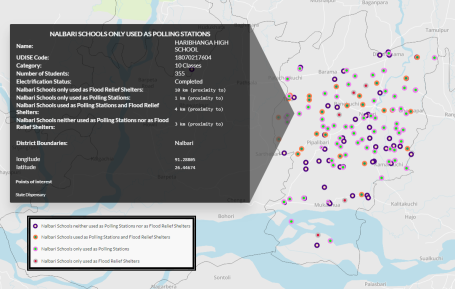
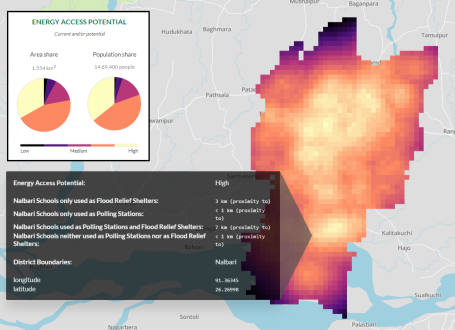
After assigning these scores, the EAE platform ran a multi-criteria analysis to identify priority sites for adding solar PV along with batteries in the district.
For the analysis, we mapped the schools, Anganwadis and healthcare facilities against data on Global Horizontal Irradiance (GHI), which indicates the solar power potential for a given area, and the Flood Vulnerability Index, which indicates how susceptible an area is to floods.
The EAE platform’s ‘Energy Access Potential Index’ then generated a list of locations which were shared with the District Administration. WRI India further supported the District Administration in conducting energy-demand assessments to determine the size of the solar PV plants required in these locations.
Why Resilient Energy Access Matters
Energy security for public infrastructure and institutions can yield wide-ranging dividends, including life-saving support and communications. In an era of escalating climate-related disasters, electrifying these institutions is crucial.
Assam’s recurring and devastating floods underscore how quickly communities can get isolated. Resilient infrastructure can prove vital in ensuring their survival and keeping them connected. Planning for resilience, with local and district authorities, helps extend these benefits across regions and ensures such institutions serve as crucial islands of refuge during disasters. With platforms like the EAE, states can direct resources to underserved areas and ensure that even small, targeted interventions can create a large impact.
EAE can also be leveraged for visualization and prioritization before a developmental organization starts working on the ground. In the past, it has been used during the inception stage of the Chief Minister’s Climate Resilient Villages Fellowship Scheme, to identify villages in Assam that could benefit from climate-resilient interventions.
Planning for climate resilience in regions like Nalbari requires a combination of local knowledge, expert analysis and robust data. By leveraging platforms such as the Energy Access Explorer, district and state administrations can prioritize interventions more effectively, ensuring that resources are allocated where they are most needed.
Learn more about how Energy Access Explorer can help decision-makers.