


A New Guide to Creating Child-Friendly Public Spaces
As Indian cities aspire to become world-class, a simpler test may be more revealing: are children able to move and play freely and safely outside their homes? If physical and social risks in a city — such as traffic, pollution and harassment — limit children’s independent mobility and safe access to outdoor play, then the city has failed to secure the rights of children. Particularly, children who often rely on public spaces because of overcrowded living conditions at home.
A new Guide to Creating Urban Public SPACES for Children, by the World Health Organization
A Practitioner's Guide to Child-Friendly Public Spaces
Public spaces can help improve children's health and well-being. A new UN guide provides support for practitioners in developing and improving public spaces for children in varied settings. Access it here.
(WHO), UNICEF and UN-Habitat, places this test at the centre of urban policy. It offers a practical, rights-based toolkit for designing streets, public facilities, open spaces and overlooked liminal spaces as core infrastructure for children’s health and development. Several case studies from India feature in this global guide. SPACES — a framework centred on safety, access, health and inclusion — offers both a vocabulary and a set of design and policy levers that can be readily applied.
Shifting Mental Models
SPACES moves beyond the idea that the playground is the only public space that matters for children. Instead, it proposes a network of interlocking spaces based on where children actually spend time. It identifies four key areas: streets, public facilities, open spaces, and liminal or “found” spaces already claimed by children.
This framing reflects Indian realities, where children’s everyday environments, especially in low-income, underserved areas, are more likely to include alleys, vacant lots, stairwells and in-between spaces rather than formal parks. SPACES treats these as legitimate starting points for design and investment, offering six principles that function as a design checklist, an audit tool and a policy framework.
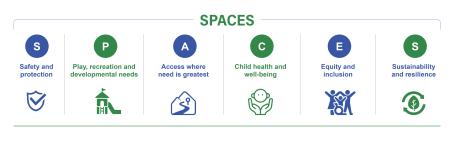
These principles are illustrated through 54 examples drawn from planned as well as informal settlements, and crisis and resilience-building contexts across the world. Several Indian cities feature in the guide, including Mumbai, Pune, Gurgaon, and the Nurturing Neighbourhood Challenge (NNC) cities, such as Indore, Jabalpur, Kochi, Kohima and Rourkela. These examples show how quickly environments improve when children’s needs shape local planning.
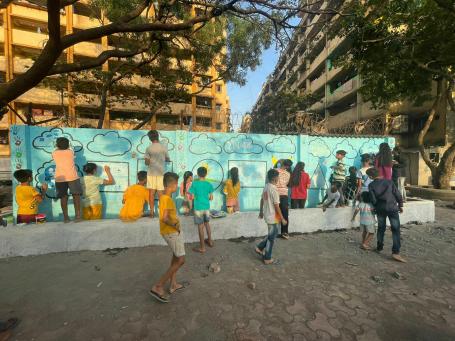
Mumbai’s Lallubhai Compound: Greening Liminal Spaces
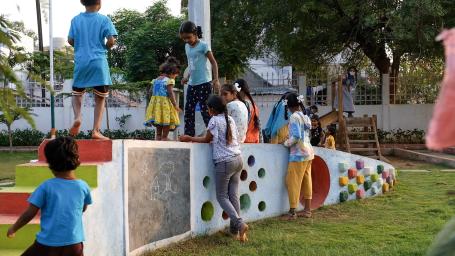
The transformation of Lallubhai Compound, a large resettlement site in Mumbai, illustrates the value of legitimising liminal spaces. To increase green cover while improving access, the project upgraded underused peripheral spaces by planting trees, painting walls, improving lighting and adding seating. These changes made the area safer and more accessible, particularly for women and girls.
This approach reflects the SPACES framework: start from where children already are, upgrade and legitimise these spaces, and link social outcomes such as safer play and greater freedom for girls to climate and health goals.
Pune’s Complete Streets: Places for Children Within the Citywide Street Network
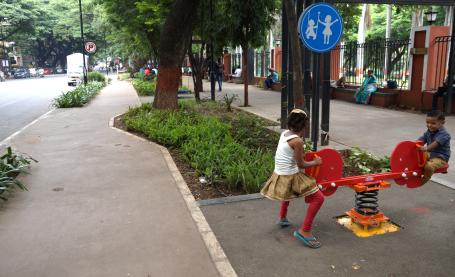
In Pune, a transport programme has doubled up as a child‑friendly public space project. Under the Smart Cities Mission, Pune’s Complete Streets Program championed by Pune Municipal Corporation (PMC) aims to transform 150 kms of roads into walkable, people‑oriented corridors.
The redesigned streets, including those by Oasis Designs Inc., feature wide, obstruction-free pavements, green buffers, seating and play pockets for children. These interventions encourage independent mobility, especially for adolescents. Such recognition of streets as a part of children’s public life, as emphasised in the SPACES guide, can help cities leverage transport investments to deliver child-friendly public spaces at scale.
Wazirabad Bund, Gurgaon: A Child‑friendly Green Corridor
The Wazirabad Bund in Gurgaon, once a neglected, flood-prone embankment, has been transformed into a 5.2 km walking and cycling corridor. Featuring tree-lined, car-free pathways and restored water systems, the project has improved children’s access to play spaces, clean air and nature.
‘IAmGurgaon’ led the initiative, with support from the Haryana Forest Department, VSPB Associates, CSR funds and community groups such as “Friends of Bund.” Today, the bund has turned into an open-air classroom on urban ecology and climate resilience — schools use it for field trips, tree planting and environmental learning.
SPACES identifies Wazirabad Bund as a strong example of a multi-functional public space — a green corridor, linear park and network of liminal pockets — that addresses flooding and pollution while improving children’s everyday environments.
Nurturing Neighbourhoods: Planning for Early Childhood
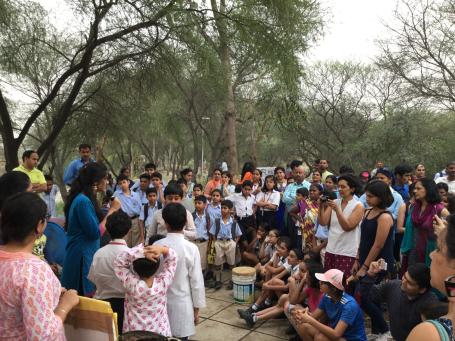
The Nurturing Neighbourhoods Challenge (NNC) is one of India’s clearest efforts to mainstream early childhood-friendly public spaces by leveraging the national Smart Cities Mission. It focuses on neighbourhood-scale planning, capacity-building of city officials and frontline workers, and data-driven approaches. NNC has helped cities identify “play-deprived” areas and reimagine streets, Anganwadi surroundings, and small open spaces as a part of the early childhood environment. early childhood environment.
Cities such as Indore, Kochi, Kohima, Rourkela and Warangal have developed pocket parks, toddler-friendly streets and co-created play spaces, proving that India’s urban “play deficit” is a policy choice, not an inevitability.
Several policy lessons from NNC align closely with the SPACES framework. It emphasises how local area planning, community participation, sustained stakeholder engagement and converged funding can help cities respond to actual needs, improve uptake and offer a clear pathway to scale and sustain interventions.
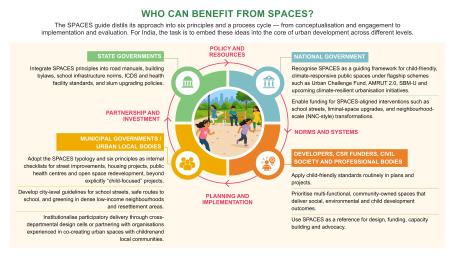
Who Can Benefit from SPACES?
The SPACES guide distils its approach into six principles and a process cycle — from conceptualisation and engagement to implementation and evaluation. For India, the task is to embed these ideas into the core of urban development across different levels.
The core message is clear: when we design for children’s right to play, mobility and a healthy environment, we design better cities for everyone.
The guide can be accessed here.
Sudeshna Chatterjee led the research and writing for the Guide to Creating Urban Public Spaces for Children, with contributions from Anupama Nallari and Chandrani Dutta.