


How Immersive Experiences are Shaping Urban Mobility
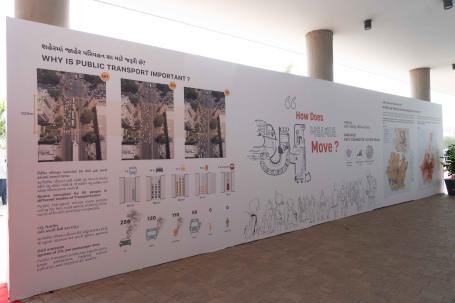
“I saw the poster outside. The first image shows heavy traffic, the second shows less, and the third shows a bus with minimal traffic,” a 12-year-old schoolgirl from the audience observed at a panel discussion on the future of urban growth in Ahmedabad. “This clearly means we should be using more buses, right?”
Her comment drew applause from experts in the room because it was clear, intuitive and grounded in what she had just experienced. This moment at AmdavadNXT, a three-day convening and immersive experience organised by the Ahmedabad Municipal Corporation under the SHIFT Transport coalition in February 2026, captures the potential of immersive engagement. By translating complex mobility data into visual, spatial and interactive formats, such experiences enable people to not just understand urban systems but relate to them.
In doing so, they shift the conversation from analysis to ‘lived’ experiences.
How Do Immersive Experiences Work?
Immersive experiences can make urban mobility tangible and relatable for people. They translate abstract data and models into formats that feel immediate and personal.
Instead of presenting information as statistics, they turn it into something people can see, feel or intuitively understand. This could be through visualisations, spatial comparisons or short videos that clearly reveal patterns and trade-offs. The goal is to move from passive information to insight and demonstrate solutions in ways that make their advantages evident, especially for things that may otherwise seem counterintuitive.
For instance, the argument that expanding roads does not resolve congestion and will only worsen it, often runs counter to public intuition. In such cases, a graphic or short video demonstrating how additional roads and flyovers have failed to ease congestion can make the insight far more compelling.
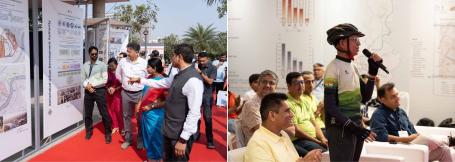
At AmdavadNXT, data on how the city moves, especially in terms of its work trips and public transport usage, were transformed into life-size maps allowing people to visualise how shifting from private vehicles to buses reduces congestion in cities.
Why Do We Need to Transform Data into Immersive Experiences?
Urban mobility discourse often remains confined to reports, policy documents and closed-door discussions. While these are essential, they frequently operate within the ecosystem and rarely reach the wider public or even cross-sectoral stakeholders.
Immersive experiences address this gap by democratising access to information. They create shared spaces where policymakers, practitioners, civil society and citizens can engage with the same data. This collective engagement helps build a common understanding of challenges and trade-offs, making it easier to align solutions.
Kirti Zala, Project Head and CEO, aProCh, a partner organization in AmdavadNXT, also emphasised how these platforms bring together stakeholders. “This rarely happens in cities, right? In Ahmedabad, we could bring together 100 partners, who, till then, were working in silos,” Zala said.
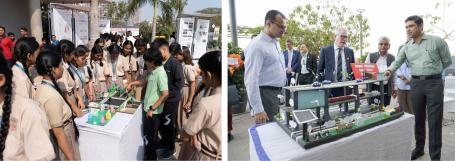
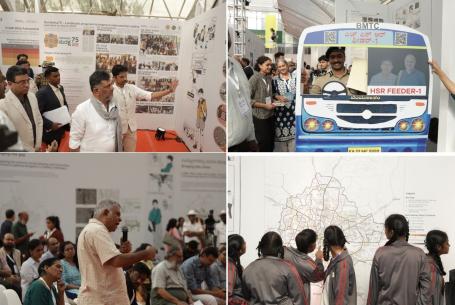
Both Namma Raste (immersive experience conducted in Bengaluru) and AmdavadNXT held panel discussions and live interactions with audiences where the stakeholders discussed a range of topics, from nudging employees to take public transport and strengthening active mobility infrastructure in cities to the role of media in shaping the mobility narrative.
These experiences also bring empathy into the room. In these moments, people encounter journeys that mirror their own or differ entirely. As these perspectives surface, conversations begin to shift. Urban mobility is no longer seen through a single lens; instead, it is understood in all its complexity. Stakeholders start to recognise what working women navigate, what mothers juggle and what operators contend with every day.
This shift transforms the nature of the dialogue itself—from opposing positions to a shared commitment to solving a common problem.
What are the Outcomes of These Experiences?
Namma Raste led to the development of a kaipidi (playbook) on inclusive road design. Insights from the convening also informed initiatives such as Shatapata (hundred), which aims to develop 100 model streets in Bengaluru. Importantly, the Bengaluru Metropolitan Transport Corporation and the Bangalore Metro Rail Corporation Limited strengthened their engagement with an organisation of persons with disabilities to incorporate universal design principles in mobility infrastructure.
AmdavadNXT brought together multiple stakeholders and partners. The latter submitted a white paper on the proceedings and the solutions that came out of the experience. The community has also formed nine working groups focused on inclusive mobility, placemaking, heritage conservation, road safety and last-mile connectivity, among others. These groups are now helping shape ongoing and future initiatives in the city.
One of the most significant outcomes of such convenings has been the creation of a shared vocabulary. Concepts such as modal share, transit-oriented development or complete streets, once confined to technical circles, are now being understood and discussed more widely among citizens.
This shift from passive awareness to active reflection is where immersive experiences demonstrate their true value. By leveraging such mediums, we can move toward inclusive, intuitive and informed urban mobility for all.
Abhijit Lokre is Founder and Partner, The Urban Lab Foundation and Sailee Rane is Strategy Lead, Ecosystem Messaging at Rainmatter Foundation. Both Lokre and Sailee have partnered for AmdavadNXT.