


How Driver Passports Can Revolutionize Mobility
India’s mobility system is undergoing a set of overlapping shifts. As vehicles adopt new powertrains and safety technologies, the demands placed on drivers are rising. Yet the systems used to select, deploy and recognize drivers have not evolved at the same pace.
The Hon’ble Minister for Road Transport and Highways, Nitin Gadkari, has repeatedly highlighted a shortage of nearly 22 lakh skilled drivers, while emphasizing the need for sustained investment in training, better working conditions and safety-enhancing technologies. These priorities are closely linked and point to a systemic challenge in how skill and readiness are identified, verified, and shared. India’s navigation of this challenge is critical to enabling more efficient and safer mobility systems.
A Layered Transition
The driver shortage is not only a question of numbers, but also of skills. Modern vehicles, longer routes, stricter safety expectations and new operational models demand different competencies than before. While training capacity is essential and expanding, it does not guarantee employment or safer operations.
Secondly, the vehicles are changing. Advanced Driver Assistance Systems (ADAS), fatigue detection sensors, vehicle-to-vehicle communication and electric drivetrains are becoming more common. Draft regulations already signal that several ADAS features will soon be mandatory for new vehicles. These systems are reshaping the human role as drivers now operate alongside them, interpret alerts and assume control when automated functions are unable to respond appropriately.
The third shift is more foundational. While skills are taught and experience is gained, trust in a driver’s readiness does not travel easily. Training records, work histories and safety information remain fragmented across employers and institutions, forcing trust to be rebuilt repeatedly. As mobility systems scale, this adds cost, time and uncertainty across the ecosystem.
In the absence of shared signals of capability, systems often rely on enforcement to manage safety. In many countries, point-based penalties for driving play an important role in deterrence, but they capture only violations, not competence. This is not an abstract problem. It shows most clearly at moments of transition—when drivers change jobs, vehicles or routes, and experience should matter the most.
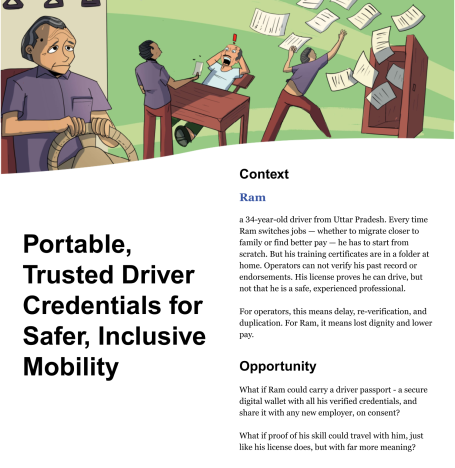
The experience illustrated here is shared by lakhs of drivers across the country. When skills and safety discipline remain local rather than cumulative, it weakens the profession itself — making entry easy, but progression uncertain and aspiration hard to sustain.
Why Skilling Alone is Not Enough?
Ram’s story shows why training by itself is no longer sufficient. Since drivers increasingly interact with assisted and automated systems, intervening in edge cases where judgement matters most, the quality of these interactions will determine safety outcomes. This makes skilling and the ability to recognize skills non-negotiable.
Investments in training, technology and better working conditions, thus, must be complemented by systems that make skills visible, verifiable and usable across the ecosystem. Without this, even well-trained drivers struggle to signal readiness, and organizations struggle to deploy people confidently to the right vehicles and routes.
Scaling Trust: The Missing Layer
Skills and experience are rarely recognized beyond local contexts, since there is no shared way to make readiness visible. India has encountered this challenge before in other domains. Population-scale digital infrastructure — such as Aadhaar, UPI and Digilocker — reduced friction in banking, benefits delivery and service access, not by judging individuals, but by making basic facts easy to verify, anywhere.
Employment and skills have not yet benefited from the same shift. Skills exist, but they are difficult to discover. Readiness exists, but it is hard to verify quickly and consistently. Therefore, individuals face delays and uncertainty, while organizations absorb higher hiring costs, longer timelines and repeated checks.
This gap can be bridged through shared infrastructure that makes opportunities and credentials discoverable and portable. Crucially, this can be done without centralizing control, allowing many actors to participate while relying on the same underlying infrastructure.
Driver Passport: Shared Digital Infrastructure
In mobility and logistics, this can take a simple and practical form: a driver passport. Where a driving license establishes the right to operate a vehicle, a passport can signal skills, experience and clearances that are currently scattered across employers and agencies.
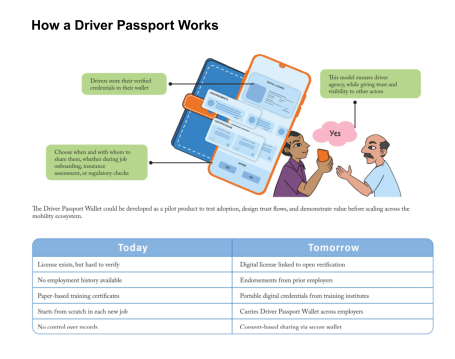
Issued once, a driver passport can be relied on many times across contexts. Breaking recognition into small, verifiable building blocks allows different actors to use it as needed. An operator, insurer and regulator may each rely on different signals, and none of them need to own the whole picture. The same foundation can support hiring, deployment, compliance or training, as needed.
Why Shared Infrastructure Matters?
Shared infrastructure changes what the ecosystem can do and encourages innovation since the basics are in place. Organizations can stop recreating the same checks and focus on outcomes instead. Training providers can design programs that translate directly into opportunity. Operators can deploy people with greater confidence. Insurers and regulators can rely on clearer, more consistent signals without adding paperwork.
Over time, this reduces friction while improving safety and efficiency across the system. More importantly, it restores a simple idea that has been missing for too long: that skill, once earned, should continue to count.
Looking Ahead
India’s drivers are operating at the front line of a rapidly changing mobility landscape. A driver passport, built on verifiable facts and trusted issuance, offers a way to support this transition by strengthening the link between training, work and progression. When readiness can be recognized at scale, driving becomes more than a job. It becomes skilled work with a future that promises trust, pride and aspiration.
Abhishek Jain works as a Consultant with the Integrated Mobility and Transport team at