


Fields of Change: Young Farmers Driving Sustainability in Madhya Pradesh
In Madhya Pradesh, an onion field is defying expectations — bigger bulbs, fewer pests and a farmer who took a chance on doing things differently. The state has been leading the transition to sustainable agriculture and has received the “Krishi Karman” award for seven consecutive years. This emphasis has led young farmers like Shivkumari and Ashish to experiment with sustainable agriculture. Their journeys reflect both the promise and the challenges of this transition.
Transitioning to Sustainable Agriculture
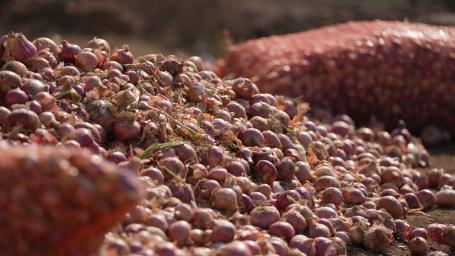
Strolling through her onion field in Chhindwara district, 38-year-old Shivkumari Verma, a farmer from Chikli Khurd village, beams with pride. Her crop is thriving, pest-free with bigger bulbs than in previous years. Her neighbouring field, planted 15 days earlier, is still not ready and shows signs of pest infestation.
“In August 2024, the team from WRI India and Samunnati Foundation visited my field and encouraged me to try sustainable agriculture, confident it would improve my yield and quality.” With support from the team, she installed a subsidised Bio-input Resource Centre (BRC) unit worth ₹32,500 that produces natural fertilisers, such as jeevamrit, by fermenting farm waste, cow dung and other organic materials over 45 days.
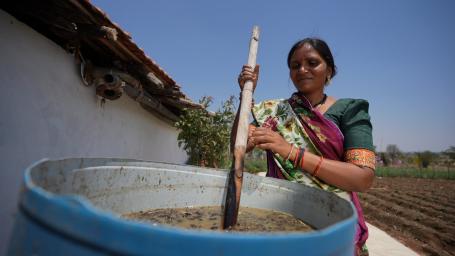
Fermented Organic Manures (FOMs), such as jeevamrit and matka khad, enhance soil microbial activity and improve nutrient availability for crops. Kanda pani (cow dung manure tea), rich in humic and fulvic acids, acts as a bio-stimulant that improves plant strength and increases crop resilience to biotic and abiotic stressors. Together, these bio-inputs increase soil organic carbon (SOC) and improve soil structure, including porosity, aeration and water retention.
She applied these across her crops, including 6 acres of wheat during the rabi season, 1.5 acres of onion in the zaid season and the annual sugarcane crop. She also used bio-pesticides such as panch patti ghol, a solution made from local plant leaves with a repelling odour, like calotropis (aak/akkaua), neem, pongamia (karanj), castor (arandi), custard apple, dhatura, etc.
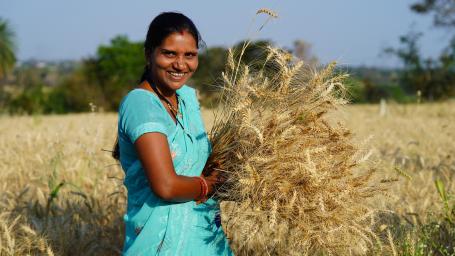
The results have been encouraging. She harvested 125 quintals of onions — more than she has in previous years — with each bulb weighing over 100 grams on average, which is significantly larger than usual.
However, the season was not without setbacks. “The hailstorm in peak summers ruined the bulbs, and we had to sell the first lot for ₹3-4 per kg, hardly earning ₹20,000. However, returns in August were close to ₹1 lakh for about 65 quintals,” she says.
Her wheat harvest was also profitable. “Last year, the yield from the bio-inputs-treated plot was higher, around 23 q/acre, while that from the conventional plot was about 18 to 20 quintals. The average rate for wheat was between ₹2,450-2,500 per quintal, but I got ₹2,525 per quintal as my grains were of premium quality,” she says.
Sustainable agriculture has also helped her reduce input costs. By reducing the usage of chemical fertilisers like diammonium phosphate (DAP) and urea, she saved around ₹3,000 in the following kharif season. She also remained unaffected by the last-minute rush or disruptions in the supply of fertilisers during peak season.
Agriculture Graduate Makes a Difference
In Harda district of Madhya Pradesh, 25-year-old agriculture graduate Ashish Dudhi made an unconventional choice. Ashish left his corporate job and returned to his village, Bichhapur, to practice sustainable agriculture and produce vermicompost. However, convincing others, including his father, has been an uphill battle.
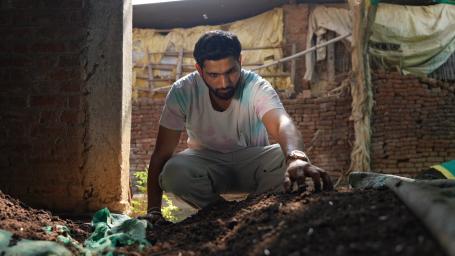
On his 30-acre farm, Ashish’s integrated approach, combining organic and inorganic inputs, has shown encouraging results. In the rabi season, wheat yield on 5.5 acres increased by 1-2 quintals compared to conventional fields, while chickpea yields grew by 1-4 q/acre. In the kharif season, soybean yields improved by 1-2 q/acre.
“I am not making the tall claim that it is only because of sustainable agriculture, as yield depends on several factors like seed, soil quality and weather conditions. But I can surely say that I have not incurred any losses,” he says with a smile.
He even observed marked improvement in the soil’s physical quality. “Excessive chemical input has degraded the soil in my village over time. But with bio-inputs, I saw a marked improvement in soil porosity and water retention.”
Challenges in Taking Up Sustainable Agriculture
Although bio-inputs have yielded positive results, both farmers faced challenges, underlining the need for a stronger support system to scale sustainable agriculture.
The use of liquid bio-inputs, like jeevamrit, poses logistical challenges. Shivkumari shares, “It became tedious and time-consuming as the process had to be repeated throughout the cropping season.” She adds that farmers prefer using solid manure, like matka khad. While her BRC unit was subsidised, most small and marginal farmers cannot afford one. She believes schemes, such as Gobardhan Yojana, which encourage farmers to utilise animal waste to produce biogas, can help.
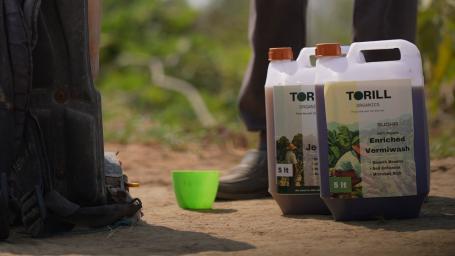
Ashish points to other practical challenges. Producing vermicompost is labour-intensive and requires technical knowledge. Despite being recognised under the Agricultural Infrastructure Fund (AIF) — a facility for financing the creation of agricultural infrastructure — small entrepreneurs like him often struggle to access credit and policy support.
While vermicompost is regulated under India’s fertiliser standards, many rural entrepreneurs remain unaware of these quality benchmarks. Additionally, no quality standards and usage norms have been set for other bio-inputs such as jeevamrit and bijamrit. Together, these factors discourage the adoption of bio-inputs among farmers.
Farmers also quote the absence of premium markets for sustainably grown produce. “We don’t get higher rates, which makes a lot of farmers feel that the additional work involved to prepare the bio-inputs is not worth it,” Ashish says.
As more young farmers experiment with sustainable practices, they are highlighting the potential and support needed for a scalable transition to sustainable farming systems. These changes may be gradual, but with the right support, they could enable a larger shift towards sustainable agriculture in India’s heartland.