


Electrifying India’s Highways: Public Charging Infrastructure for E-Freight
This blog is the first in a three-part series on Highway Electrification for Zero-Emission Trucks.
Trucks are a familiar sight on Indian highways. Painted in vibrant colors and embellished with catchy phrases, they carry everything from food grains to smartphones and keep the wheels of India’s economy moving. However, they are also a major source of tailpipe emissions and air pollution along transport corridors.
Medium and heavy-duty trucks (MHDTs) are the backbone of India’s freight sector. Though they make up just 3% of the on-road vehicle fleet, they move more than 70% of domestic freight and contribute nearly 53% of road transport emissions, worsening air pollution. Electrifying MHDTs is therefore a critical step India’s decarbonization pathway.
Source: Niti Aayog’s Report Fast Tracking Freight in India. Graphic by Anusrita Kundu/WRI India.
Understanding the E-Truck Ecosystem
Most MHDTs operate on medium to long-haul routes, connecting markets, warehouses and ports across the country. Long-haul freight refers to the movement of goods across states or countries, often covering distances beyond 400 kilometers. In India, an estimated 75.4% of total road freight movement is long-haul. This means that much of the country’s freight demand relies on the ability of these trucks to run on intercity and interstate highways.
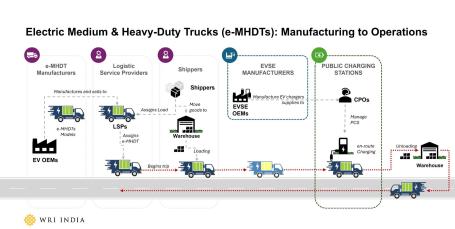
This requires a robust e-truck charging ecosystem that is based on close coordination between vehicle original equipment manufacturers (OEMs), logistics service providers (LSPs), shippers who procure the freight services, electric vehicle supply equipment manufacturers (EVSE OEMs) and infrastructure operators. EVSE OEMs design and supply fast-charging hardware and power systems that enable electric trucks to charge quickly and run longer. Public charging stations and charge point operators then deploy these technologies across highways and logistics hubs, forming the operational spine of India’s emerging charging networks.
Need for Charging Infrastructure
Replacing diesel trucks with electric ones without disrupting the movement of goods requires reliable, high-power charging along highways at major freight corridors, logistics hubs and rest stops.
Recognizing this need, the Ministry of Heavy Industries (MHI) earmarked ₹2,000 crore under the PM e-Drive scheme and released Operational Guidelines for EV Public Charging Stations (2025), to expand public charging infrastructure, including battery swapping or fast charging stations, across cities and highways. The guidelines also provide 70–80% subsidy support for the electrical systems needed to supply power to charging stations located on highways and transport hubs, including bus depots, airports and fuel outlets, to improve deployment and flexibility for fleet operators.
Does Infrastructure for Passenger EVs Work for E-Trucks?
Battery size and range requirements differ significantly across vehicle categories, impacting both vehicle design and the charging infrastructure required to support them. This raises an important question: Can the charging infrastructure built primarily for passenger EVs effectively serve electric trucks? The short answer is not yet, because heavy-duty trucks have fundamentally different energy needs.
Passenger electric cars generally carry batteries in the 30–70 kWh range, suitable for daily commutes or short intercity travel. However, trucks and buses, which are designed to carry heavier loads over long distances, require much larger battery packs and higher power input for charging.
Currently, India’s public charging ecosystem is predominantly built around passenger EVs, particularly four-wheelers and light commercial vehicles, reflecting the early focus of the EV transition. Most installed chargers across cities and highways cater to power outputs of up to 150 kW, which adequately serve these segments. However, this is insufficient for e-MHDTs. As India’s EV landscape matures, the next phase will demand higher capacity charging infrastructure for intercity e-buses and e-MHDTs.
Understanding the battery size and range of currently available e-MHDT models is key to planning this infrastructure. These factors determine how much energy trucks consume per trip, how frequently they must recharge, and what charging capacity is required along specific highway stretches. As shown below, based on available e-MHDT models in India, currently battery size ranges from 60 kWh to 540 kWh, with driving ranges spanning 100 km to 300 km. These operational characteristics make frequent enroute charging essential for long-haul freight.
Battery size distribution of e-trucks in India. Source: Based on brochures of available e-truck models. Graphic by Anusrita Kundu/WRI India.
Range distribution of e-trucks in India. Source: Based on brochures of available e-truck models. Graphic by Anusrita Kundu/WRI India.
To keep freight operations efficient and minimize downtime, charging systems must align with these high energy demands. While the Ministry of Power recommends a minimum power of 120 kW for each charging gun for highways, long-haul trucks with battery capacities exceeding 200 kWh require even higher capacity systems. International experience and emerging market trends suggest that chargers in the 250–500 kW range (Level 4 chargers under BIS standards) are best suited for en route charging of e-MHDTs.
By aligning charging infrastructure with these requirements, and by understanding the power output capabilities currently available from EVSE OEMs, India can ensure that both light-duty EVs and energy-intensive, heavy-duty trucks are adequately supported.
The Road Ahead
India’s freight electrification journey is gradually gaining momentum, but large-scale adoption of e-MHDTs will require EV infrastructure planning, particularly along key corridors. Developing high-power freight corridors with chargers of 250-500 kW at strategic intervals can help support long-haul e-truck operations.
This would require public–private collaboration that brings together logistics companies, state utilities, OEMs and government agencies to plan and co-invest in corridor-level charging. As India moves towards a cleaner freight future, building a reliable, high-capacity public charging network will be the cornerstone of making zero emission trucking not just possible, but practical and scalable.
The second blog in the series will explore the infrastructure requirements for high-power chargers along highways.