
Connect Karo 2026 Opens with Focus on Energy Transitions, Emerging Urbanisation and Climate Resilience
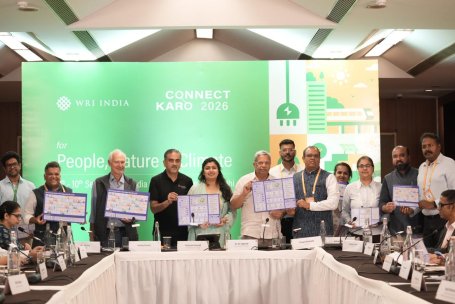
New Delhi, 9 September 2026: WRI India’s flagship convening, Connect Karo 2026, opened today with discussions on some of the most pressing questions shaping India’s development and urban future, from accelerating the transition to sustainable public transport and planning for rapidly changing transitional urban spaces to creating inclusive public spaces and building more resilient rural energy systems.
The sessions brought together 1,500+ thought leaders, decision-makers, practitioners, academics, scientists, civil society organisations, students and other stakeholders to examine how India can respond to the interconnected challenges of rapid urbanisation, climate change and economic transition. Discussions explored the need for better data, governance, financing and partnerships to build cities and communities that are more sustainable, inclusive and resilient.
As part of the public transport session, Dr OP Agarwal, ex-joint secretary, Ministry of Urban Development and professor of practice at the Indian School of Public Policy said, “Mobility systems are much like the circulatory system of the human body. You cannot build only the major arteries and expect the system to function; you also need the capillaries that connect every part of the body. In our cities, we have invested heavily in building metros, but often without building the ‘capillaries’ that make them truly accessible and useful - the last-mile connectivity. We need to go beyond building infrastructure in isolation and understand how people make travel decisions.”
The sessions on Day 1 examined how India can accelerate the transition towards more sustainable, inclusive and resilient cities. Discussions looked at financing the green transition, catalysing finance for sustainable transport and logistics and behaviour-led approaches to sustainable urban mobility. Sessions also explored creating inclusive and resilient public spaces, strengthening governance and partnerships, and improving planning and financing for India’s emerging urban areas.
Other highlights of the 2-day convening include the "WRI India Data Lab," an immersive exhibition offering hands-on exposure to over 15 open-access data tools, and "Playing for the Planet: WRI India Game Room," a curated interactive experience using gamified planning tools to bring climate change and sustainability to life.
Speaking about the significance of the convening and WRI India’s 15-year journey, Madhav Pai, CEO, WRI India, said, “As WRI India marks its 15th anniversary, Connect Karo reflects our commitment to bringing diverse stakeholders together around the ideas and solutions that can shape India’s future. From clean energy and food systems to public spaces, mobility and net-zero transitions, these conversations are about connecting knowledge, partnerships and action to address the complex challenges facing India’s cities and communities.”
Key Launches at Connect Karo 2026
- Decent Green Jobs as a Pathway for Fair Urban Transitions: A Study of Bengaluru’s Buildings Sector: Maps emerging green jobs in Bengaluru’s buildings sector and highlights the need for better skilling, labour protections and gender inclusivity to ensure a fair urban transition.
- A Methodology for Site Suitability Assessment of Green Hydrogen Hubs in India: Develops a GIS-based methodology to identify suitable locations for green hydrogen hubs, assessing resource availability, demand and infrastructure across states.
- Silt Load Measurement and Investigation of the Effectiveness of Road Dust Cleaning Mechanisms in Three Indian Cities: Measures road silt loads and assesses cleaning mechanisms in Mumbai, Indore and Ahmedabad to identify more effective approaches to road dust management.
- City Tier-Wise Open Waste Burning Characteristics: Examines open waste burning across 11 Indian cities, highlighting differences across city tiers and the need to strengthen municipal systems to address the problem.
- Institutionalising Mobility Demand Data Collection Processes across Indian Cities: The paper recommends that India should establish a national, periodic household mobility survey, implemented through the National Sample Survey system.
- Tattva: A WRI India platform to bring together and build stronger and more resilient ecosystem through compliance, governance and accountability.
About WRI India
WRI India, an independent knowledge organisation registered as India Resources Trust, provides objective information and practical proposals to foster environmentally sound and socially equitable development. Through research, analysis, and recommendations, WRI India puts ideas into action to build transformative solutions to protect the earth, promote livelihoods, and enhance human well-being. Know more: wri-india.org
For more information, please contact:
Tanushree Venkatraman | [email protected]
Satbhan Singh | [email protected]
