

RESTORE 2026: Livelihoods, Climate and the Future of Landscapes
India’s landscapes are central to the country’s food production, water security, biodiversity, livelihoods and climate resilience. Challenges like climate change, land degradation and changing patterns of land and water use are altering the conditions under which India’s landscapes function, with almost 30% of India’s land already degraded.
Rising temperatures, heat stress, changing rainfall patterns, droughts, floods and increasing water stress are affecting forests, farms, rivers, wetlands, grasslands and other ecosystems as well as communities who depend on them. For example, more than 700 million people in India depend on forests and agriculture for sustenance, including approximately 89 million tribal people who depend on forests for their livelihoods. The challenge is not simply to restore degraded landscapes, but to build ecosystems that can remain productive and resilient as conditions change.
India has already established significant foundation for this transition. Under the Bonn Challenge, India committed to restore 26 million hectares of degraded land by 2030 and has reported 21.76 million hectares brought under restoration efforts, generating approximately 1.22 billion person-days of employment. Large-scale public programmes have also created significant infrastructure for natural resource management, providing an important foundation for landscape-scale restoration.
The next challenge is quality, coordination and long-term stewardship. Restoration at scale requires better decisions about where and how to intervene; stronger alignment across government programmes and investments; appropriate finance; credible monitoring; and meaningful participation by communities and local institutions.
About RESTORE 2026
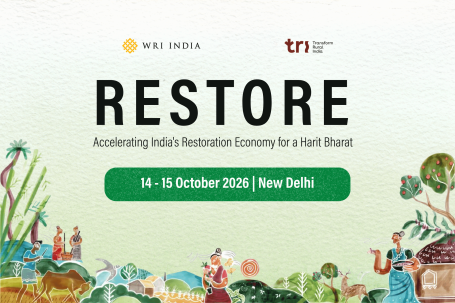
RESTORE 2026, the second edition of the national dialogue on landscape restoration, is co-hosted by WRI India and Transform Rural India (TRI) on 14-15 October 2026 in New Delhi. Under the theme “Livelihoods, Climate and the Future of Landscapes,” the two-day dialogue will bring together government, philanthropy, finance, business, technology, civil society, researchers, practitioners, entrepreneurs and community leaders to explore what it will take to shape resilient and productive landscapes for the future.
The dialogue will explore three interconnected questions:
- Livelihoods – How can healthy landscapes support rural incomes, employment, food systems and economic opportunity, while strengthening the natural resources on which livelihoods depend?
- Climate – How should changing climate risks influence the way landscapes are assessed, planned, restored and managed?
- Future Landscapes – How can India move from individual restoration projects towards coordinated, landscape-scale action that brings together ecological priorities, livelihoods, institutions, finance, technology and local knowledge?
RESTORE 2026 will bring these perspectives together to examine how India can build landscapes that continue to provide food, water, livelihoods, biodiversity and protection from climate risks as conditions change.
Landscape Stories
RESTORE 2026 is hosting ‘India’s Landscape Stories’, a curated exhibition showcasing place-based restoration experiences, livelihood and value-chain innovations, community stewardship, restoration enterprises and digital tools from across India. Together, the dialogue and exhibition will bring evidence, experience and emerging approaches into conversation and explore what the next phase of landscape restoration in India could look like.
Join the conversation and help shape the future of India’s landscapes.

