

Powering State Climate Action: Using the Energy Policy Simulator to Model Maharashtra’s Low Carbon Future
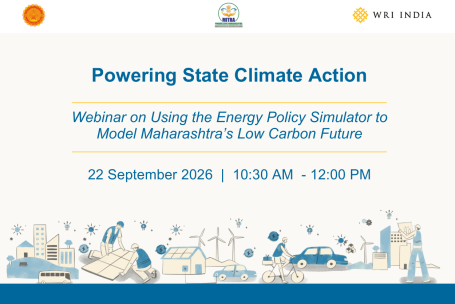
Maharashtra’s updated State Action Plan on Climate Change (MH SAPCC) and Viksit Maharashtra 2047 vision set out ambitious goals for inclusive economic growth, environmental sustainability and climate action. Achieving these priorities will require models that help assess the long-term implications of policy choices across sectors.
One such model is the Maharashtra Energy Policy Simulator (EPS-MH), jointly developed by the Maharashtra Institution for Transformation (MITRA) and the State Climate Action Cell (SCAC), Department of Environment and Climate Change (DoECC), Government of Maharashtra, in partnership with WRI India.
EPS-MH is an open-source economy-wide model designed to support evidence-based planning. It enables users to explore how different policy pathways could affect Maharashtra’s energy use, GHG emissions, employment and economic growth. The model covers key sectors of the state’s economy, including transport, electricity supply, buildings, industry, agriculture and land use, as well as areas such as hydrogen supply, district heat and waste management.
By bringing together sectoral insights and economic considerations, EPS-MH can help stakeholders examine the potential implications of different policy choices and identify pathways that align climate action with Maharashtra’s development priorities.
This webinar by MITRA, in collaboration with WRI India will introduce the model, demonstrate its applications and discuss how economy-wide modelling can support evidence-based climate and development planning in the state. It will bring together policymakers, researchers and practitioners to explore the role of state-specific modelling tools in informing Maharashtra’s energy transition.
