

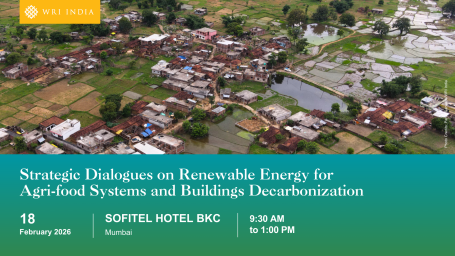
Strategic Dialogues on Renewable Energy for Agri-food Systems and Buildings Decarbonization in India
The WRI India Energy Program is hosting a series of strategic dialogues on the productive use of renewable energy (PURE) and buildings decarbonization. Each session is designed as a cluster dialogue and accompanied by the launch of a WRI India report.
AGENDA
Session 1 | 9:30 AM – 11:00 AM
Lifting All Boats: Productive Use of Renewable Energy for Sustainable Rural Livelihoods
This session will mark the launch of WRI India’s new report examining the role of PURE in agrifood-livelihood systems, drawing on an analysis of 21 projects implemented across nine Indian states. The research forms part of WRI India’s broader Energy for Equitable Development initiative, which explores how data, technology, policy, and finance can be aligned to deliver affordable, reliable, equitable, and sustainable energy access.
Moving beyond questions of technical feasibility and economic viability, the report foregrounds the socio-economic contexts in which PURE interventions are embedded. It interrogates how access to technologies is shaped, who participates in decision-making, how power is distributed across actors, and who ultimately captures value from these systems. By centring questions of inclusion and agency, the session will invite reflection on how decentralized solar energy applications can be designed to support more just and resilient agricultural transitions.
Tea Break | 11:00 AM – 11:30 AM
Session 2 | 11:30 AM – 1:00 PM
Energy Transition in India’s Buildings Sector: Unlocking the Next Frontier of Decarbonization
This session, jointly convened with the Alliance for an Energy Efficient Economy (AEEE), will spotlight the governance landscape shaping India’s buildings-sector energy transition.
We will launch the Energy Transition Preparedness Initiative (ETPI) Buildings Sector Study Report for FY 2023–24, an update to the earlier FY 2020–21 assessment (read here), and present key findings from the latest analysis. The report highlights emerging trends in the sector, showing how national policies continue to guide state action while several states are developing innovative approaches and institutional mechanisms to strengthen implementation. It also outlines state-specific priorities and opportunities for cross-learning to advance energy transition outcomes. The session will delve into the report’s insights and explore pathways to accelerate a clean, efficient, and equitable buildings-sector transition.
Together, these sessions aim to bring peer organizations, donors, industry bodies, policymakers, practitioners, and other key stakeholders into a constructive exchange on clean and reliable energy, energy transition pathways, and equitable development.
Should you require any further information, please feel free to reach out to Arundhita Bhanjdeo at [email protected] for Session 1 and Deepak Tewari at [email protected] for Session 2.
